Four key social media strategies

Candyland by John Morgan

Is your business using social media as part of its overall marketing strategy? Do you consider the relative social influence and authority of customers? And if so, do you tailor customer service, pricing or product selection as a result?

A research study from the Harvard Business Review has found that companies actively using social media practice one of four distinct strategic approaches, all of which are dependent on the organisational culture, what the company is seeking to achieve in terms of results and their tolerance to uncertainty.

The study – which was the result of an analysis of over 1,100 companies leading social media initiatives from multiple industries and continents – sheds light on how businesses are adopting social media practices in different ways to meet product and corporate business objectives.

The research study identified four key social media strategic approaches:

1. The predictive practitioner

Companies using this approach focus their social media efforts on a particular area of the the business, for example customer service, R&D or sales support.

Comcast, the US-based telecommunications company, uses Twitter to deal with complaints and customer service issues, whilst Asos, the online fashion retailer, has led the way in F-commerce, selling shoes, clothes and other accessories directly through Facebook.

2. The creative experimenter

A ‘creative experimenter’ utilises social media to ‘test’ ideas and concepts as a way of improving functions and practices. A company taking this approach will often use sites such as Facebook, Twitter and LinkedIn to listen to internal and external stakeholders and use tailored platforms such as blogs to create a two-way dialouge with customers.

5 years ago Dell set up Direct2Dell, it’s first official presence on the social web and the gateway to Dell’s community portal. Through this gateway, various other blogs, forums and groups have been set up to encourage Dell customers and employees to interact, share ideas and ask questions.

3. The social media champion

The ‘social media champion’ approach is a step up from the two previous strategies. ‘Social media champions’ utilise social media on a much grander scale, for example as part of a nationwide or international promotional campaign.

In 2010, Ford launched a Facebook-centric social media campaign called the Ford Focus Global Test Drive. The campaign invited bloggers, social media authorities and Facebook friends to share their experiences with followers and friends following the first global consumer test drives of the new Ford Focus. The campaign required joint efforts across marketing, communications and senior executives, and generated an increase in awareness and leads, prompted test drives and raised thousands of pounds for good causes.

4. The social media transformer

A ‘social media transformer’ is a company prepared to embrace social media entirely and ensure it permeates across multiple departments and areas throughout the organisation. A business using this approach will involve both internal and external stakeholders, including senior managers, agencies and customers to enable innovative social media interactions.

Last year Cisco launched their Integrated Workforce Experience (IWE), a social business platform enabling collaboration and knowledge-sharing for both employees and external associates. The IWE created a centralised knowledge and information ‘hub’ and functions like a Facebook ‘wall’, with real-time news feed updates on employees’ status and activities, and information on business projects and partner interaction.

Implementation

Recognising strategy is one thing, but putting it into practice is another. It’s important that any organisation planning to use social media have clear goals and objectives beforehand to ensure that it aligns with the overall business and corporate strategy. Businesses new to social media should start off at a lower level, as a ‘predictive practitioner’ or ‘creative experimenter’, to test social media in specific areas or departments within the company. Only once confidence has been built (and depending on what the company wants to achieve) can they start to strategically ramp up efforts and aim for the next stage.

Effective strategy implementation is critical, not only to ensure that objectives are met but also to avoid potentially disruptive problems. Companies without a clear social media strategy are prone to ad-hoc and un-coordinated experiments, that despite the best of intentions, may leave them looking unprofessional and amateurish.

Does your company use social media as part of its marketing strategy? If so, which of the four strategic approaches does it fit into?
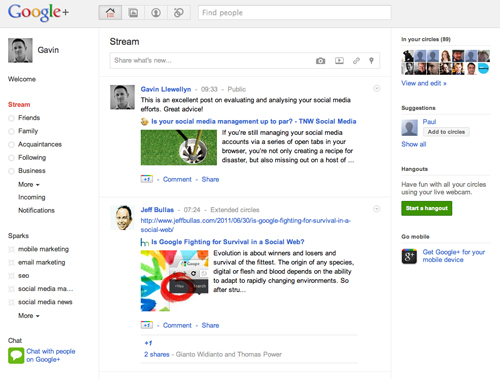


Google Plus – My first impressions

Google+

Google+, the new social networking platform from Google, has caused a bit of a stir in social media circles (no pun intended!) over the past ten days or so. Since Google announced a limited number of invites to the ‘Google+ Project‘, the blogosphere has been buzzing with views, reviews and opinions.

Google+ is intended to be more than a social product or strategy, but an extension of Google itself. Google have described other online tools as being rigid, either forcing us into ‘buckets’ or being completely public. Real-life sharing is nuanced and rich and that’s something Google+ is attempting to replicate within their software and through Google+’s three key elements:

Circles – Users can place different friends and/or contacts into different circles, depending on what they want to share and with whom. Friends can go in one circle, business contacts in another, technology geeks in another and so on.

Hangouts – Hangouts allow you to let specific people or entire circles of contacts know you’re ‘hanging out’, thus making impromptu video chats with up to ten connections at once possible.

Sparks – Google describe this element as a ‘sharing engine’, where users can type in any interest they have and links to content – blogs, pictures, video or books – will be stored in the users’ interests list for future reference.

So, after playing around for the past few days, here are my initial thoughts and impressions of the platform:

Style and feel

I like the aesthetics and presentation of Google+. It feels clean and neat without appearing plain. The functionality is simple and unfussy, allowing me to easily drag and drop people I’d like to follow into circles and manage what I want to update, see and read in a very straightforward way.

An asymmetric social network

Like Twitter, Google+ is an asymmetric social network, which means that you can follow others without them having to follow you back to see and share their content. This gives you a lot more choice about what you want to see and Google+ therefore feels like the best bits of Facebook and Twitter in one!

Segregated lifestream experience

In a very similar way to Twitter’s lists feature, Google+’s Circles allow me to separate my contacts into different groups so that I can easily choose which content to view and from whom. Facebook and LinkedIn have both irritated me at times because I am unable to easily separate who I want to get updates from, and I’ve sometimes had to resort to hiding people’s updates as a way of streamlining my newsfeeds.

Choose who to talk to

When I’m on Facebook, I don’t often post business or marketing-related updates for fear of boring some of my friends! And on Twitter and LinkedIn, I’m often faced with the opposite problem – whether to post a more personal update without appearing unprofessional. Google+ lets me pick and choose who to talk to and about what so that I can tailor my thoughts and opinions to specific audiences.

Another social network!

The dilemma many people will face is whether or not to invest the time and energy in another social network when there are others already in place. Many will have established themselves, as well as their friendship/ contacts groups, on LinkedIn, Facebook and/or Twitter, so why bother doing it all over again for something new?

Google+ is still being developed and like all the other social networks will be updated and changed on an ongoing, iterative basis. I personally haven’t got an issue building up a presence on Google+ (although I’m biased being a digital marketer). The true test will be whether Google+ can start tempting away some of Facebook’s 750 million members!

In summary, I agree with Mitch Joel’s philosophy that “everything is ‘with’, not ‘instead of'”. I already use Facebook, Twitter, LinkedIn and other social sites like YouTube and SlideShare to speak to different audiences in different ways and I will do the same with Google+ – at least until they (or any other social network) give me a compelling reason not to!

Are you on Google+? If so, what are your first impressions? And what are your predictions for the future?!


My three words for 2011

three colours smoke by Julian Burgess
On the 1st January this year, I wrote a blog post called ‘My 3 words for 2011‘ in which I outlined the three key words that I hoped would form the guiding pillars for what I would focus on for the year ahead. The three words were not intended to be goals (which should be SMART), but guiding lights for my actions and efforts in both my personal and professional life.

Now that we’re over half-way through 2011, I thought it would be a good idea to review my three words and briefly reflect on how I’m getting on:

Create

As a marketer, I believe I should be always be looking to create. I see my work as art and this should involve continually producing new and interesting achievements that make people think.

This year I set up and launched my new blog, One Too Many Mornings. The blog is all about marketing but with an emphasis on social media and digital communications and I’m proud of this creative achievement. However, my overall aim is to consistently create quality blog posts which I hope other people will find useful and be shared with the networks and communities the posts and untended for. That is the next challenge and I’m very much looking forward to it!

Ship

Seth Godin is a big inspiration for me, and he – along with many others – regularly influence my thinking and actions. Like many of us, I’m often prone to procrastinating and putting off certain tasks and chores- as well as being a bit of a perfectionist at times! One of Seth Godin’s mantras is that you should always look to ship. Shipping is about getting things done, be it hitting the ‘submit’ button on your latest blog post, finishing a speech or completing the first chapter of a new book you’re writing.

Working on something (or ‘thrashing‘) is fine, but eventually you’ve got to complete.  One of my biggest achievements so far this year has been designing, preparing and publishing my blog. I could have spent six months working on concepts and ideas for it, but I realised that although the aesthetics are important, content is king, and I therefore looked to get things off the ground sooner rather than later and make any further changes incrementally over time.

Improve

With time seemingly passing by more quickly than ever, I’m constantly reminded of how far behind I am compared with those I aspire to be like. So one of my aims for this year has been to improve, both personally and professionally, whether it be fitness, relationships, reading or training. I want to be able to look back in December and know that I’ve made a noticeable difference in my life.

So far 2011 has been a year of change for me and one of the biggest changes in my professional life came with my decision to move on from the company I had been working at for the past three years. One of the biggest motivations was the need to improve. I needed a new challenge, a fresh perspective and a change of scenery and together this has allowed me to progress and develop as a marketer.


With another six months to go until 2012 the key is to persevere and carry on. I’m pleased I’ve made inroads and managed to stick to my three words but as always there’s still work to do. My hope still is to be able to look back on 2011 and be proud of a numbe rof achievements.

What are you aiming to achieve by the end of 2011? Do you have any personal or professional objectives?


Keeping presentations simple but effective

With this phone... Apple will rule the world!!! by Erik Pitti

Last Sunday I was fortunate enough to be invited to the christening of a friend’s daughter. I don’t often go to church so before I got to the venue I was beginning to dread the usual clichés: that the service would be long, boring and dull and that the vicar would witter on about things that I have no interest in.

As it happened, I couldn’t have been more wrong. The service was short, sweet and to the point and the vicar was both professional and entertaining. I think anyone could have learnt a trick or two from a seemingly simple christening service and the vicar demonstrated a number of sound presentation skills:

Know your audience

It was clear from the outset that the vicar knew his audience. There was a real mix of guests (religious and non-religous, old and young) and he made sure he delivered a service that appealed to as many of us as possible. He thought about things from the audience’s perspective and presented in a style that engaged as many of us as possible.

Tell a story

Reciting extracts from the bible without a clear context is likely to disengage a mixed audience. So the vicar used stories and a straightforward narrative about the christening and the baby’s spiritual journey to grab our attention and create an emotional connection with the audience.

Entertain

The vicar used a little magic, open questions and audience participation to spark our interests and keep us engaged. He asked us to try and remember about 20 words that he reeled off in one go. Individually, we could only remember about ten at the most. But collectively we could recall all twenty – a reminder that together we can do more and help one another.

Project your voice

A sure fire way to bore your audience is to mumble or talk too quietly. No matter how interesting you are, if nobody can hear what you’re saying they’re likely to switch off. Although the vicar had a microphone he didn’t need to use it. He stood up straight and projected his voice from his lungs rather than his throat to produce a clearer sound so everyone could hear.

Don’t read

A speaker that relies too heavily on notes and is constantly looking down clearly doesn’t know their subject and this lack of confidence will be picked up by the audience. The vicar (unsurprisingly, I suppose!) knew his subject off-by-heart and was therefore able to deliver a flowing, confident, seamless service.


Overall I had great time at the christening and came away from the service feeling both enlightened and educated – a clear sign that the vicar had presented well and done his job!

When I think of great presenters Steve Jobs is a perfect example. His ability to present in a simple but remarkably effective way (with genuine passion and verve) is fascinating. Check out his iPhone keynote speech from 2007 – considered one of his best.

What do you look for in a great presentation? Do you have any presentation hints and tips you’d like to offer?


6 steps to polishing your personal brand

Cubist Cowboy by H. Michael Karshis

This post was inspired by an article in the March 2011 edition of the Harvard Business Review by Dorie Clark.

Whether we like it or not, we all have a personal brand. We are not defined by who we think we are, but by how others perceive us. And with the increasing power of search engines and social media sites, it’s also becoming more and more important to consider how Google, Facebook and LinkedIn see us, too.

So what can we do to ensure we’re maintaining our personal brand and showing the world the person we want to be seen as?

1. Plot your course

By defining where you want to go and the direction you’ll need to take will allow you to determine where best to invest your energy. When I decided to specialise in digital marketing, I researched the area by immersing myself in social networks (particularly Twitter), connecting with others through blogs and attending conferences and workshops.

Ask yourself: “What do I need to know?”. Part-time or freelance work in particular disciplines will help build your skill set and may also provide you with the opportunity to shadow experts or even take on a mentor. Further education may be another option to build expertise and gain extra confidence.

2. Define your USP

What’s your unique selling point? Use your points of difference to your advantage to stand out from the crowd. If you’re looking to ‘re-brand’ by moving into a new discipline, work out how you can bring something different and add value to your new role.

Sir Clive Woodward applied business philosophy picked up from an earlier career at Xerox to rugby coaching. Clive Woodward’s professional and business-focused approach to sports management ensured the England team won both a Grand Slam and the World Cup in 2003 and became the most successful England rugby coach ever in the process.

3. Tell your story

Develop a narrative that explains how your past, your interests and your skills fit into your present. You may want to move from a professional career into the arts. But in order to avoid being thought of as a ‘dabbler’, you need to to effectively explain how your past skills and competences translates into your newly chosen field.

Wherever you can, turn your strengths into weaknesses. An English graduate who’s been waiting tables but looking to move into retail might be told they don’t have the necessary experience. But by telling the right story they can say they’ve gained valuable front-line customer service skills, a sense of initiative and the the ability to work under pressure.

But wherever you plan to go, your narrative must be consistent with your past . Don’t ever abandon your roots and core values.

4. Assert yourself

Making contacts with people you know is easy. But to others who are not already acquainted with you it will be a lot tougher – especially if you’re reinventing yourself in a new field of work

As you begin to build your personal brand, ensure all contact points are up-to-date and strategically educate friends and contacts through online channels such as email, Facebook, Twitter and LinkedIn. These are the people who will act as recommenders or leads for you and your work.

When you begin reaching out to others, do so personally. Call them on the phone or email directly. Use LinkedIn to network and to connect with other specialists in your field. It’s OK to ask people you don’t know to join your network as long as you do so tactfully and make your intentions clear.

5. Showcase your skills

Whilst your building your network, start showcasing your skills. Use blogs, podcasts, videocasts and social networks to demonstrate and establish your expertise whilst adding value to the networks your participating in.

Secure your own internet domain and start a website to illustrate your unique intellectual property. Share content in a blog as a taster to what you can really deliver once somebody commits to a project/ contract with you.

Having your own online presence will increase your chances of getting published in industry-leading publications and websites as well as speaking opportunities at industry conferences and trade associations. All of this will help you to increase your visibility, connections and credibility.

6. Be committed

Be consistent and committed as you move forward. The key to success is long-term effort and determination. So stay focused, remain professional and make the effort to learn the specific dialects, nuances and trade secrets in your field of expertise.


All in all, be strategic about identifying how you wish to be perceived. Develop a narrative, build your network and showcase your expertise.

Think of the process as ‘search engine optimisation’ for your life! The more connections, value and content you add, the more likely you’ll be known, recognised and sought out.