Sportsmanship

Top Notch... by taylorpad212 on Flickr

It was a genuine pleasure to witness an excellent example of good sportsmanship during the most recent cricket Test match between England and India. Despite trailing – and during a crucial period in the game – India graciously agreed to withdraw an appeal for a run-out which they had every right to uphold. Although the laws of the game were adhered to, due to the nature of the dismissal the India captain MS Dhoni reversed his decision because he wanted to ensure the game was played in the right ‘spirit’.

Fairness and decency

Great sportsmanship such as this is a reminder that fairness and decency can still exist even during the most intense and high-pressure of sporting arenas. Cricket is like a religion in India, followed fanatically by its supporters who worship the team and its stars. But even against this backdrop of enormous weight and expectation, a gesture of sporting goodwill took place, setting an example not only for the millions of aspiring young cricketers throughout India and the world but other professionals, too.

Sportsmanship can exist anywhere

I believe that good sportsmanship can and should take place in every profession or industry. Honesty, fairness and sincerity should form the backdrop of any workplace – be it an office, factory, law firm or sports team. I don’t have a problem with playing hard in order to get where you want to and achieve your aims. But I also believe that this should be complemented with good manners, giving credit where it’s due and being up front and honest with others. I have no time for gossips and energy sappers. I like to work with people I can trust to work hard, show sincerity and demonstrate integrity in everything they do.

An example to us all

The Indian cricket team showed us all that sportsmanship can exist even in today’s increasingly cynical and fickle world. They may have lost to England in the end, but they won an awful lot of respect and admiration from many people both within and outside the world of cricket.

Do you have any inspiring stories of sportsmanship? What are your views on how one should conduct oneself in the workplace?


5 awesome marketing podcasts

Studio Microphone by curtis.kennington

I love to catch up on all the latest marketing news, opinion and insights. And with everything in the world of digital marketing and social media moving so fast, it’s becoming increasingly important to keep on top of the trends.

However, I also love to go walking and unfortunately it’s a little complicated to read magazines (such as Marketing Week, The Marketer and the Harvard Business Review) blogs and newspapers whilst out for a stroll!

But that’s where podcasts come in so handy.

There are a lot of marketing podcasts out there (just search ‘marketing’ in the podcasts section on iTunes) but in my opinion there are only so many good ones. So I’ve decided to share with you 5 marketing podcasts that really deliver:

Marketing over coffee

The Marketing Over Coffee podcast is hosted by John Wall and Christopher S Penn and is recorded every week in Boston, Massachusetts.

I like Marketing Over Coffee because it’s a good length (about 30 minutes long) and covers both traditional and new media marketing, giving me a fairly rounded perfective on what’s happening across the industry. John and Chris like to go into detail about many of the latest trends and regularly refer to the Marketing Over Coffee LinkedIn group.

The BeanCast

The BeanCast is a weekly discussion programme hosted by Bob Knorpp and featuring a different set of experts every week who consider the latest stories in the world of marketing.

Like Marketing Over Coffee, the show covers both traditional and digital marketing but in a little more detail over the course of an hour. I enjoy the BeanCast for the debate amongst the panel and the opportunity to hear a longer discussion on some of the key marketing topics of the moment.

Six Pixels of Separation

The Six Pixels of Separation podcast is hosted by the Mitch Joel and is recorded and published nearly every Sunday. Each week, Mitch interviews a different guest in which they chat about a subject the guest is particularly involved with (the guest is sometimes promoting a book so they will often use a key topic from this as a talking-point).

Unlike the previous two podcasts, Six Pixels of Separation has much more of a digital marketing slant but nevertheless features thought-leaders from advertising, sales, analytics and the creative industries. Mitch Joel is a brilliant thinker alone, so the combination of Mitch and another guest is often compelling listening.

The Hopkinson Report

I was introduced to The Hopkinson Report after it’s host, Jim Hopkinson, appeared on the Six Pixels of Separation podcast!

Jim works as a marketer for Wired.com and he brings his experience and expertise to the podcast, which includes a great mixture of guest interviews, top tips and guides on everything from website creation and social media to healthy living and salary advice.

The Bottom Line

The Bottom Line is a business discussion programme and podcast from the BBC that features a changing line-up of CEOs and business leaders from many of the UK’s biggest corporations.

Although it’s not a marketing podcast, as such, marketing is often a key theme and nevertheless the economic, business strategy and innovation topics that are often the main focus of discussion underpin good marketing practice. I therefore believe the Bottom Line is essential listening for anyone serious about good business analysis.

What marketing/ business podcasts do you listen to? I’d love to hear your recommendations.


Outsourcing social media

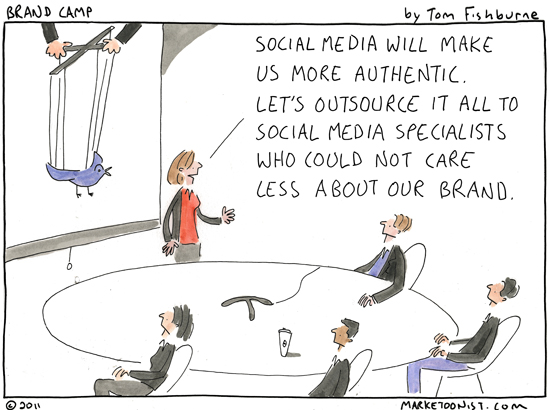
Outsourcing social media by Tom Fishburne

With social media catching the attention of more and more companies, it seems that many are opting to outsource some or even all of their efforts to third party agencies.

Is this a good idea?

Well, it depends. It depends on what you’re looking to outsource and to whom. For a lot of companies, social media is a daunting new area and it is understandable that some may require assistance. If an agency can help with education, training and the development of blogs and social media channels, as well as monitoring, measuring and reporting on activities, then this can add a great deal of value and help ensure that the client company is using social media correctly.

However, if an agency is expected to take full control of the entire social media process – from concept to day-to-day management – then this is where problems can arise.

Collaboration is key

If you’re going to use a marketing or PR consultancy to assist you with your social media marketing then it’s important to have a clear idea as to how the process between you (the client) and the agency will work.

An agency’s role should be to help the client shape the social media strategy and develop a clear operational plan. It’s important at this stage for the agency and client to work together and reflect on what the company is hoping to achieve at a corporate level. A crystal clear understanding of the brand, the company’s position within the market and its business objectives is an essential step in the creation of an effective social media marketing plan.

Authenticity is paramount

Once a company and a supporting agency have defined how social media will be used, the client should assume full control of content creation.  Authenticity is crucial to establishing trust through social channels and is not something that can be mimicked by others. In addition to the risk of appearing insincere, allowing someone else to tweet, blog or post for you is essentially telling the world that anyone can imitate your brand identity, culture and everything it stands for. Surely you’re worth more than that?

Social media is about developing relationships and creating a two-way dialogue between real people, not logos and brand names. It’s therefore important for you – not an outsourced consultancy – to lead the conversation and form a genuine connection with your customers and online constituents.

What are your thoughts on this subject? Do you outsource any of your social media efforts?


SEO basics – 5 key steps

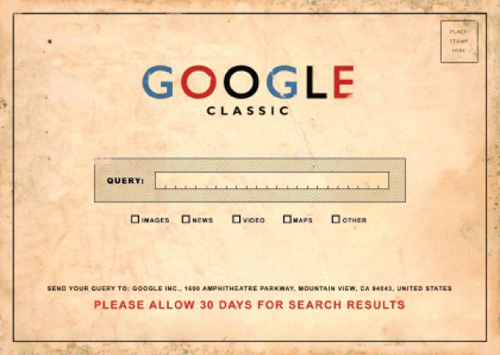
Google Classic by Brett Jordan

Search engine optimisation (SEO) is the process of optimising a website so that it can be more easily found by search engines. The better the standard of optimisation, the better the chance of getting your site higher up the rankings.

The power of major search engines like Google (who have a world-wide market share of nearly 84%) means that getting highly ranked increases the likelihood of getting an improved level of qualified traffic to your website for a particular group of keywords and phrases.

Although getting onto the first page of Google is a very tough task, it’s still important to optimise your website. And in addition to working towards improving the discoverability of your website, following basic SEO principles is also good for accessibility, navigation and design.

What follows are five basic steps to good SEO:

Keywords

What is your site about? What are the key topics and themes? Brainstorm keyword ideas with staff members and colleagues (including senior management) to consider the keywords that you would like your site to be associated with. If possible, speak to customers and other external stakeholders and ask them what they would put into a search engine to find what you have to offer.

Once you’ve chosen a list of keywords, use Google’s AdWords keyword tool to assess keyword data by country and territory, search volumes and competition. There’s no point trying to optimise for highly competitive terms, for example ‘insurance’. Instead, focus on the long tail and go for a term like ‘affordable family health insurance’. This term generates far less searches but is much more specific and therefore easier to rank for.

Title tags and descriptions

Apart from content, the title or title tag is the most important on-page SEO element and appears at the top of the web browser and within the search engine results pages (SERPs) above the description. It is the main text that defines what a web page is about and although it’s important to include keywords in the title, it’s also essential that it accurately and concisely (65-70 characters with spaces) describes the page’s content.

The meta description is shown in the SERPs below the title tag and is a key piece of information for a user. It should be a short paragraph (160-170 characters with spaces) that advertises what the page is about in an inviting and engaging way.

Although the description does not affect search rankings, keywords should be included in order to attract a searcher’s attention and generate click-throughs to the web page.

Header tags

Like a good newspaper article, a web page should be broken into headings and sub-headings. The heading (or h1 tag) is the most important and should be used to draw the reader in. As well as being bolder or in a larger font, it should also include keywords. The sub-headings (h2, h3, h4, etc) are usually smaller but also include keywords and break the page into logical sections.

Header tags are important for SEO as they let search engines know what’s ‘important’ on a web page. Therefore, main keywords should be included in the main header as well as the other headings as this – along with the title tag and body content – will tell a search engine bot what the page is about.

Content

Although the ‘technical’ aspects of SEO mentioned above are vital to good SEO, more than anything, content is king. Content on websites should never be produced solely for SEO, as this is not only bad practice but also far less effective than it used to be.

In my opinion, many of the best sites around contain brilliant content that is original, natural and human. And content doesn’t just have to be copy. Content can also include images, video, infographics, slideshows and podcasts. The key is to create great content that will add value and make people take notice. That way, content will be read, shared … and linked to!

Link-building

If you produce consistently good content then others will be more likely to link out to your site. Every time another site links to you consider this to be a ‘recommendation’ or ‘testimonial’. Search engines use links (quantity, but especially quality) to determine how websites are related to one another and in what way.

If a site has a good number of quality links (i.e. not from link farms) from other relevant, subject-related websites, search engines will determine that the site must be good. Link-building is an incredibly important aspect of SEO but to get good links it all comes back to producing good quality content!


I’ve not gone into a great deal of detail in this post – I just wanted to provide a brief overview of things to consider. For more detailed information and advice, please visit my Delicious SEO bookmark pages.

Feel free to add your thoughts, ideas and advice on SEO basics in the comments – I’d love to hear from you!


Know your (social media) audience

Frontiers 2011 - Day 2 By frontiersofinteraction

One of the things that frustrates me on LinkedIn is the number of people I follow who set their account to automatically share all their tweets simultaneously on Twitter and LinkedIn. What I’m often left with is a LinkedIn newsfeed crammed with – well, people’s tweets!

This problem is two-fold…

First of all, if I’m connected to someone on LinkedIn, there’s a good chance I’m also following them on Twitter. That means that when I log into LinkedIn I want to experience a social environment with updates and news related to my connections’ professional lives and not a carbon copy of their Twitter stream.

Secondly, automating tweets to LinkedIn means that any tweet, regardless of context or subject matter, is updated as a LinkedIn status. Since when is “Had a great time last night… roll on next Friday – only 6 days to go!” a suitable update for LinkedIn, a professional social network?

A wider social media issue

This isn’t a problem exclusive to LinkedIn and Twitter but one related to social media as a whole. And it gains even more importance when brands, companies or professionals are concerned.

It’s one thing for someone who only casually uses social media to (knowingly or unknowingly) syndicate updates to multiple social networks, but another one entirely when a company or brand does so. It’s vital that if social media is to be used professionally (say, for example, as a marketing tool) then it must be used correctly.

Know your audience

It’s important that any person, brand or business intending to use social media in a meaningful – or even better, strategic – way understand that each social media platform must have its own raison d’ete. I have often visited a company’s Facebook page only to see update after update of links to their own blog posts. Unless you are a major brand or celebrity it’s highly unlikely anyone will want to ‘like’ your Facebook page.

Facebook should have it’s own unique experience for users and add value to their newstreams. By all means link back to your blog posts, but what is it that you’re offering your Facebook fans exclusively? The same is true for other platforms, including the company blog, Twitter stream and LinkedIn page. All must have their own, distinctive personalities whilst at the same time compliment each other and the overall brand.

Do it right – or not at all

I’m a firm believer that unless you’re prepared to take the time to investigate who your audience is, where they hang out (online) and prepare a social media experience tailored to them and the platforms they’re using, then it’s not worth using social media at all. It’s far better focusing on a targeted and well-maintained blog and Twitter presence, for example, than spread yourself thin across multiple social networks that are left unvisited with ten or twenty updates from two years ago.

Every online presence – whether it’s your website or within a social media site- is an opportunity to make a first impression. Don’t let clumsy use of social media spoil such an important encounter with potential colleagues, business partners, prospects or customers.


5 reasons why your business should blog

Blah Blah Blog 2.Green by H. Michael Karshis

I was a little surprised recently when a client suggested to me that blogging was really only something celebrities and hobbyists indulged in. Although the comment took me aback, I nevertheless politely told them that they were way off the mark – and gave them a few good reasons why!

Blogging isn’t just for big name personalities, gossip-mongers or ‘rock star’ internet marketers. It’s something anyone – or any business – can successfully pursue as long as the blog is organised, well-written and targeted at the right audience.

Here are 5 simple reasons why I think your business should be blogging:

1. Stand out from the crowd

How many of your competitors are blogging? And if they are, how good are they? The chances are that despite the web becoming increasingly more social and interactive, many companies do not have a (good) company blog.

By setting up and executing a varied, interesting and engaging blog you can begin to create a competitive advantage. A great company blog will include a diverse range of blog posts, from research take-aways and top tips, to infographics and opinion pieces – all of which will give readers – and your customers – a good reason to keep coming back. And as they do so, you’ll have started to create an interested community, all of whom will be well aware of your brand and the product and services you have to offer.

2. Build brand awareness

A great company blog will allow you to write openly and objectively about the subjects and issues related to your industry that you feel passionate about. It’s important that you have an opinion and illustrate this in your blog posts. And it’s OK to be controversial (within limits). This will give your blog a personality that will differentiate you from others.

A company blog shouldn’t be overly focused on your business – keep news items and product updates for a ‘news’ page. Instead, the blog should compliment the business aspects and problems your company products/ services can solve. For example, Blue Sky Factory, an email marketing company based in the US, have a blog which regularly offers tips, tricks and advice on how to improve your email marketing strategies. They rarely talk about themselves but as a regular reader of their blog you become very aware of them and much more likely to call on them for professional (paid) help.

3. Establish thought-leadership

By becoming a proficient blogger within your field of expertise, you can set yourself up as an opinion-leader and a ‘go-to’ person within your space. by doing so, you can continue to build brand awareness as a result of increased media appearances, speaking engagements and interviews.

Martin Lewis, aka the ‘Money Saving Expert‘, is a perfect example. As an outspoken but professional voice on all things money-related, he’s established himself as a respected authority on consumer-focused money issues and is regularly called upon my media outlets for his take on news stories and matters related to this subject.

4. Share information

A blog is an excellent way of removing the corporate barriers and revealing a human side to the company. For me, a great business blog isn’t afraid of sharing information and ideas openly with readers and customers.

I liken it to how TV chefs operate. You’ll regularly see them on television demonstrating how they cook the perfect roast chicken, or publishing recipe books. Yet if they’re giving away their secrets, why are they still in business? Because they use all their other skills (influence, personality, network knowledge etc) to build on the food they produce to create an experience for the consumer that you and I could never replicate. They give away small pieces of information in exchange for building up their own reputations and brands.

5. Improve search engine optimisation

Search engines love any website that has regularly updated, keyword-rich and – most importantly – engaging, valuable content – and a blog can achieve all of these brilliantly.

The primary reason for a business blog should not be to improve SEO but for a combination of the other four reasons listed above. Nevertheless, a great blog that offers regular content that adds value is much more likely to be indexed for your keywords and be linked to by other industry-related websites, improving your site’s link popularity and consequently boosting search engine rankings.

What reasons do you have for starting a company blog? Or do you have any reasons for not setting up a business blog?