Who would you invite?

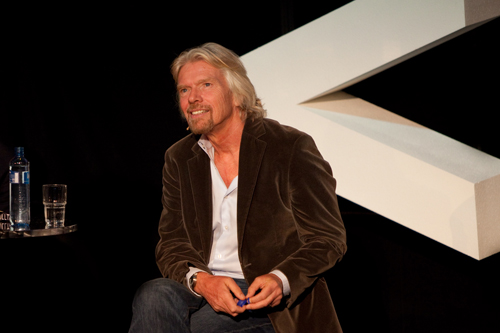
Sir Richard Branson by Jarle Naustvik

I was pitching to a client a few weeks back for a project and we got to discussing the project’s goals, the company profile – and me. They asked me a number of questions about my skills and experience and then surprised me with the following:

“If you could invite three people – dead or alive – to a dinner party, who would they be?”

I have to admit, as great a question as it was, I’d never been asked something like this before so I had to think on my feet. It was clear that the client was looking for someone they could form a good working relationship with and this question – informal yet probing – was aimed at digging a little deeper into what makes me tick. I thought for a few seconds and before I knew it I could think of about twenty three people! But three was all they wanted and, knowing that my answer to their question could be a deal-breaker, I gave them the following:

Richard Branson

Richard Branson was the first name to pop into my head when I first heard the question. I read Richard’s autobiography back in 2003 on a (Virgin) flight back from the US and it really caught my imagination. His passion, sense of humour and sheer determination to succeed shone through on every page and it re-ignited a sense of entrepreneurism inside me. Richard is also a larger -than-life character – certainly not a dull suit from the business world – and his track record in public relations and promoting his businesses speak for themselves.

Whether you run your own business or work for someone else, I believe it’s essential to have an enterprising spirit in order to consistently innovate and challenge conventions, otherwise life can become monotonous and the potential for group-think looms large. Sir Richard Branson’s philosophy is all about creating something new and being a pioneer, regardless of who you are or where you work.

Seth Godin

I first heard of Seth Godin whilst at university about seven or eight years ago. It was his book The Purple Cow that stood out for me in a bookstore one time and it immediately made me want to pick it up and start skim-reading. It was immediately apparent to me that Seth is a brilliant and provocative thinker and before I knew it I was hooked. Apart from the numerous books he’s written, Seth is also a great speaker and prolific blogger.

Seth’s key message in The Purple Cow was about standing out and being remarkable. What’s the point in following other’s and producing a ‘safe’ product or service? It’s much more fun (and potentially profitable) to find your niche a make an impact of your own.

John Lennon

If I was asked to name four people to invite to a dinner party I may have been tempted to have said John, Paul, George and Ringo! The Beatles have been an inspiration for me ever since I listened to my dad’ old 78 record of ‘The Blue Album’ back in the mid 1990s. But it was always John Lennon who I could relate to most. His character, back-story and song-writing style, along with his willingness to experiment and innovate, have always appealed to me and (partly due to his tragic death in 1980) has always been a legendary figure and cult figure for me and millions of others.

John Lennon may not have been a business person, but there’s still so much we can all learn from what he did and how he thought. He was an artist with a passion for creating brilliant work that he believed in, which is something that I’d like to be remembered for myself in years to come.

I could have picked many more dinner party guests but I’m happy with the three I chose. Which three people would you invite ? And why?


Planning and preparation

Manchester United Campeón 2010-11 by americanistadechiapas

“By failing to prepare, you are preparing to fail” – Benjamin Franklin

I’m a huge sports fan and I love watching football, rugby and cricket in particular. The excitement and drama these sports generate is what really captivates me and millions of others. But as a business professional, I can’t help but focus on the immense professionalism that exists within these sports.

As skilful and entertaining as the players are, meticulous planning and preparation from the entire squad, management and backroom staff is what gives elite sports teams the real opportunity to succeed. Without it, victory is always a further step away.

Prepare like a winner

The planning that goes into making a successful sports team is the same as that which goes into any operation intent on making improvements and aiming to be number one. Whether you’re a professional speaker, a corner shop, a teacher or a multinational corporation, success is intrinsically linked to effective planning.

But what are the real benefits of planning and what can it do for you?

Provide direction

A decisive plan will give you the direction you need and provide you with a goal, a set of objectives and a strategy to reach them. Without it you may well flounder and miss out on opportunities that could otherwise have be taken.

Reduce uncertainties

Planning and preparation allows you to assess what problems may or may not exist and give you the chance to put strategies in place to tackle them.

Allocate resources

What will you need to meet your objectives? How many people? What type of people? What kind of equipment is required? Planning gives you the opportunity to answer these questions and make a forecast of everything you might need to meet your objectives.

Anticipate action

What is the competition doing? What plans might they have? Don’t blindly assume but make an educated assessment of what actions you might have to take based on a set of different scenarios. Competition can come in the form of many things (direct and indirect) so have a plan outlining the various courses of action you can take.

Facilitate assessment

Whatever happens, you will need to assess how you’ve performed. By planning ahead you can work out how, what and when to make those assessments and put a framework in place to make it happen. Feedback – good and bad – is essential and will give you the data to figure out what went well and what can be improved next time.

Make good decisions

More than anything, good preparation allows you to make better decisions. The more information you have to hand, the better prepared you’ll be to use that knowledge to make the right decisions and ultimately give yourself the best possible chance of success.

Do you have any planning and preparation tips for success?


Twitter and the art of engagement

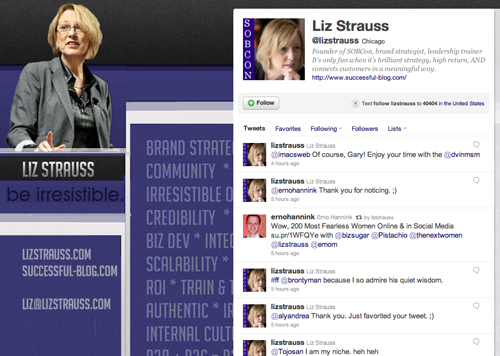
Liz Strauss on Twitter

I’ve seen people and companies use Twitter in a variety of ways and this innovation is great.

Frank Eliason at Comcast (who has since moved on to Citi) and Richard Binhammer at Dell were pioneers of using Twitter as a customer service platform, responding to customer queries and complaints and even proactively seeking out issues that could be resolved. Coffee Groundz use Twitter as an ordering service, allowing customers to tweet in their coffee order and have it ready for them to pick up in advance.

Although many companies successfully use Twitter as curation or information networks, they often follow very few people back, which I believe goes against the natural ethos of what Twitter is about (Twitter is about human interactions and networking).

Liz Strauss is a great example of someone who uses Twitter brilliantly for aggregating and curating interesting and valuable pieces of information, but also as a networking and communication tool. If you take a look at Liz’s Twitter page, in addition to inspirational posts and links you’ll see an endless list of mentions and replies to others.

Liz Strauss is an expert networker and someone who builds successful professional networks. Liz is also someone who really understands what Twitter is about – the art of engagement.

All those replies and retweets show how Liz responds and interacts with her network. Twitter shouldn’t be used for shouting your opinions and broadcasting news, but as a communication channel where dialogue and conversations can be fostered. By doing this well you can begin to build credibility and be seen by others as someone who is willing to share and contribute to the community.

But how can you begin to build a genuine and engaging Twitter presence:

Be consistent

However you choose to use Twitter, make a plan and stick to it. Consistency of appearance is important and it demonstrates to others that you’re not using Twitter on a bit of a whim. Engagement is key and it’s important to show up and join in the conversation on a regular basis. Don’t leave big gaps between updates.

If you do decide to create an information or curation network using Twitter make this clear in the bio so that people don’t get frustrated if you don’t reply to them.

Don’t over tweet

Showing up and participating is essential, but don’t tweet so much that you annoy your followers! Endless tweeting can clog up people’s timelines and they might decide to un-follow you.

It’s also important not to labour the point regarding a particular issue or subject matter. By all means tweet about it, but know when to stop!

Mix and match

Don’t tweet the same type of message over and over – it gets boring!  Even if you work in a relatively unglamorous industry, not all of the tweets need to be about product launches or what industry meetings you’re attending. Try and have a bit of fun once in a while and tweet about local events, sporting occasions or charitable causes. This will help ‘humanise’ your brand and encourage interaction from the community.

Take an interest

Engagement also involves taking a genuine intrest in what others are doing. Take the time to check out what others are talking about and respond, comment or Retweet their content. It’s surprising how simple gestures like this can make someone’s day.

Be interesting!

Whatever business you’re in, make your tweets interesting. Just look at what Home Depot is doing on Twitter. They post a variety of different tweets relevant to their target market (DIY), as well as responding and conversing with followers.


Listen up!

"His Master's Voice" by Beverly & Pack

As the web becomes increasingly social, more people and communities are taking the opportunity to talk about you, your company and brand – whether you like it or not. The questions is: are you listening?

The social web is an incredibly democratising space, allowing anyone and everyone to become a publisher. Blogging, microblogging, social networking and video sharing are just a handful of ways in which people are giving their opinions and sharing their thoughts with their friends and numerous friends of friends spread out across their social graphs.

Don’t be shy!

The social landscape can be daunting and rarely takes prisoners as many small and major brands have found out the hard way. But as unnerving as it may be for some, for those willing to accept and embrace the social media philosophy, the social web can be a considerably liberating environment, allowing brands, business leaders and celebrities to connect with their followers in ways that weren’t possible only a few years ago.

We shouldn’t hide away and shirk our responsibility when encountering comments, jibes and negativity online. Years ago it may have been possible to send out a series of defensive press releases and spin your way out of a problem. But today it’s far better – and easier – to front up and deal with the situation on your constituents’ terms – by using social media. Use new media to your advantage. Enter into a dialogue, discover the problems (and root causes) and make a genuine effort to solve them in a meaningful way. There’s no hiding place online so why not jump in and get involved.

Some simple ways to listen

But how do we know when customers or stakeholders are talking about us? Well, there are a number of different ways to monitor and listen in to the various conversations taking place and here are just a few:

Twitter Search

Twitter’s search engine is a great tool for finding out who’s talking about you and your brand right now in real time. Just type in the key words you’re looking for and Twitter Search will relay what’s being said in order of time and popularity.

Google Alerts

Google Alerts will send you an automatic email notification whenever Google finds new results for content from web, news, blogs or forum discussions that match specific user-selected search terms. Use it to track mentions of your name, company/ brand name, employees and competitors. Check out this article on how to use Google Alerts effectively.

Google Blogsearch

Google’s blogging-specific search engine lets you to put keywords into the search bar and see what people are saying about you on blogs around the world. Use this tool to seek out influencers, taste-makers and opinion leaders and tell them your story. Much better than sending a generic press release to a bunch of uninterested newspapers!

Technorati

Technorati is the home of blogs and tracks what’s happening on the 100+ million blogs in existence. Although Technorati will let you do exactly the same thing as Google Blogsearch, despite some overlap it’s important to capture both. You can also click on the orange RSS subscription button, copy the link and put it into Google Reader or another RSS reader as a listings search to get automatic notifications of keywords you’re interested in tracking.

These are just a few tools. There are many other ways to listen.

“The conversations that don’t kill you will only make you stronger”*

It’s unlikely that everything being said about you online is negative, but some of it might be, and just because you’re not listening doesn’t mean that the chatter isn’t taking place. And if you or your management team are concerned about losing control by embracing social media, then consider this – you never had control in the first place!

It’s much better to be involved in the conversation than not. So stop worrying and get involved.

This post was inspired by a section from ‘Engage‘, a fantastic book on social media by Brian Solis.


Social media heavyweights

Cat's Cradle by cliff1066™

During the early part of the year I published three blog posts outlining a number of ‘social media heavyweights’ – people and resources that I consider to be outstanding in their field as publishers and curators of social media expertise. Many of these ‘heavyweights’ can be found in the ‘Great blogs’ column on the right-hand side of this blog and as part of a Twitter list I compiled. However, I’ve decided to highlight some of these and explain a little about what each of them mean to me.

Seth Godin

Blog: http://sethgodin.typepad.com
Twitter: @thisissethsblog

Seth Godin is a marketing and business leadership mastermind who has been producing brilliant books for many years and blogs every day. Seth is a massive inspiration to me because his thinking and philosophies are so simple yet so motivational.

Chris Brogan

Blog: http://www.chrisbrogan.com
Twitter:@chrisbrogan
Facebook: http://www.facebook.com/ChrisBroganMedia
YouTube: http://www.youtube.com/chrisbrogan

Like Seth Godin, Chris Brogan often updates his blog daily, and like Seth he always has something worthwhile to say. What I like about Chris is that as well as philosophical posts and insightful musings, he also offers very helpful advice and tips from personal development to social media best practice.

Mitch Joel

Blog: http://www.twistimage.com/blog
Twitter: @mitchjoel
Facebook: http://www.facebook.com/MitchJoel

I first stumbled across Mitch Joel when I saw his book ‘Six Pixels of Separation’ listed as a top social media book on Mashable. Needless to say, I bought his book and I’ve been a dedicated fan ever since.

‘Six Pixels of Separation’ is also the name of Mitch’s blog and podcast, the latter I consider to be one of the best digital and marketing podcasts around, in which Mitch regularly interviews interesting and amazing people throughout the media, marketing and advertising worlds.

Brian Solis

Blog: http://www.briansolis.com
Twitter: @briansolis
Facebook: http://www.facebook.com/thebriansolis
YouTube: http://www.youtube.com/briansolistv

Brian Solis’s book ‘Engage’ is a must read for anyone serious about understanding the true power and potential of social media. Brian is a real enthusiast and looks at social media from every angle, be it tactics, strategy, philosophy and analytics. Check out Brian’s YouTube channel where you can watch ‘Revolution’ – a series in which Brian interviews the people involved in social media for some of the biggest organisations around the world.

Mashable

Website: http://www.mashable.com
Twitter: @mashable, @mashsocialmedia@mashbusiness … and more and more! (Just search ‘Mashable’ in Twitter to see all their accounts)
Facebook: http://www.facebook.com/mashable
YouTube: http://www.youtube.com/mashable

Mashable is probably the resource for breaking news, analysis and comment on everything to do with social media. It’s a goldmine of social media information and resource.

Jeremiah Owyang

Blog: http://www.webstrategist.com/blog/
Twitter: @jowyang

Jeremiah Owyang is a web strategist and new media ‘big thinker’ who strives to get under the skin of digital and social media marketing trends. Jeremiah’s in-depth reports and insight are second-to-none and he regularly blogs on a range of both strategic and tactical social media issues.

These are by no means all the social media heavyweights around. There are so many more. But these are just a few of them that have inspired me. Have you got any others you’d like to share?


Up in the cloud

Clouds by karindalziel

This week Google announced that it would be releasing the Chromebook, a low-cost netbook fitted with Google’s Chrome OS, which essentially means a laptop with a web browser. Manufactures who’ve signed up to producing laptops exclusively with Chrome OS (instead of Microsoft’s Windows) include Samsung and Acer, who will be building machines that will apparently boot up in 8 seconds and be malware free.

The gathering cloud

The interesting issue for me regarding this story is that users of Google’s Chromebook will be relying solely on software stored in ‘the Cloud’. Although this might seem like a radical concept for many people, most of us are already accessing email, social networks, photos and more using web-based applications so this could well be a natural step further in that direction.

Although the trend has been towards tablets instead of netbooks, the revolution is less about the hardware and more about the philosophy and thinking around how software is used. Individuals using Google’s Chrome OS means that as long as they’ve got an internet browser everything is accessible, wherever they are and on whatever computer they have access to at any one time. The user experience is always kept simple and identical.

A challenge to Microsoft?

Google is also posing an interesting challenge to Microsoft. Businesses use Windows because it’s so simple to use and saves money on training and infrastructure. But if more companies go the way of Samsung and Acer and begin installing a simple operating system like Google’s, encouraging users to access web-based applications, how will Microsoft be affected in the long-term?

It will be interesting to see how this develops going forward. How much will we all depend on ‘the Cloud’ in the future? And how will Google’s competitors respond?