How I use my social networks

My social networks

Social networking has become a huge part of our lives, so much so that it’s becoming increasingly difficult to escape them whether we’re online or not!

Many people use social networks for both personal and professional reasons and I wanted to share with you a little insight into how I use them.

Facebook

I was quite late to join Facebook and was pretty much coerced into doing so by my friends in 2007! However, despite my initial reluctance I joined and was soon hooked.

Although the early hype and excitement has long since dissipated, as a marketer I am conscious of Facebook’s power and potential and I still use it myself primarily for personal use, although recently a lot more to read and share content for professional reasons, too.

How I use Facebook

  • To see what my friends (and friends of friends) are getting up to (admit it, we all like to be a bit nosey sometimes!)
  • Share selected photos. I don’t put all my photos on Facebook, just a few that I feel my friends might appreciate
  • Send direct messages. I’ve found a lot of my friends prefer to DM within Facebook instead of using traditional email
  • Subscribe to RSS feeds (pubic posts) of prominent people within the marketing, social media and business communities
  • I ‘Like’ the brand pages of the companies I, well, like! The good ones (e.g. Coca-Cola, Red Bull, Starbucks) are fun, informative and offer much more than just a re-hash of their company news, blogs and Twitter updates
  • I syndicate my blog posts. Although my Facebook ‘audience’ isn’t my main target, I syndicate some of my posts here anyway whenever I think it’s appropriate to do so (I rarely share technical posts as I know this may leave some of my friends baffled)

Twitter

Although I knew about Twitter since its launch in 2006, I didn’t join until February 2009. Like many, I was a little confused as to how I could get the most out of it. But after an awkward start I soon got into a rhythm and it’s now my number one social network (for now anyway).

I use Twitter primarily for professional reasons but I do like to read and share other content, too. I believe it’s important to have a good balance.

How I use Twitter

  • I use Twitter like a mini RSS feed to monitor and read updates as they appear in my timeline. I like to see what’s happening in business and marketing NOW and Twitter’s great for real-time updates
  • I use lists to group my followers into manageable streams, for example ‘Social media essentials‘, ‘Marketing‘ and ‘Technology
  • TweetDeck and HootSuite are brilliant dashboards for managing my various streams. I tend to use TweetDeck on my iMac and MacBook Pro and the Hootsuite app on my iPhone
  • Twitter is great for syndicating my blog posts and I get the best return in terms of reading and sharing when I’ve posted a link to my blog on Twitter
  • Hash tags are a very handy way of identifying either my posts or someone else’s with a particular trend or topic

LinkedIn

LinkedIn is the world’s pre-eminent social network for business and professional networking and just like with Facebook and Twitter I was relatively late to the party.

Many people regard LinkedIn as an online destination to upload your CV but it is much more than that. It’s important to understand how to use LinkedIn effectively.

How I use LinkedIn

  • I’ve completed my profile and ensured it is up-to-date with what I’m up to professionally. As with my CV, I include information on my role within a company along with my responsibilities and achievements
  • I never share unprofessional content and links on LinkedIn (e.g. sports news, celebrity gossip, random facts etc). I believe it’s important to use LinkedIn as it should – as a professional social network
  • I do not connect my Twitter account to LinkedIn and only ever syndicate my tweets on LinkedIn when it’s appropriate to do so
  • I try to connect not only with people I know but also people I don’t know but would like to network with, for example marketers, managers and directors from within the marketing and social media industries
  • I have joined a number of groups around subjects I am interested in and asked and answered questions. It’s important to participate
  • I syndicate my blog posts on LinkedIn through the update field but I have also installed apps that integrate my blog and Slideshare account within my LinkedIn profile

Google+

Unlike with Facebook, Twitter and LinkedIn, I was a very early adopter of Google+, joining only days after its launch in July this year. It’s fascinating being a part of a social network as grows and develops but the main reason I have joined Google+ is because of it’s potential.

For me, Google+ sits somewhere between Facebook and Twitter although I see it (at the moment at least) as a long-form version of Twitter. None of my non-marketing/ business/ tech friends are on Google+ yet so I use Facebook to network with them and Google+ to network with the geeks!

How I use Google+

  • As I mentioned above, I tend to use Google+ as an extension of my Twitter feed. I’ll often post similar updates to both Twitter and Google+ but the advantage of Google+ is that I can add a little extra commentary to augment the post
  • I therefore use Google+ to share longer, more detailed updates. Depending on how it develops, I may one day post orginal blog posts into Google+ itself rather than linking out to my website
  • I use Circles to group different people depending on what they post about most. Circles allow me to streamline my news stream
  • As with all the other main social networks, I syndicate my blog posts on Google+ in an attempt to get more coverage and traffic to my blog

Other social networks

Whilst I mainly use the four social networks mentioned above, I also use a number of others, notably Instagram, Foursquare and Slideshare. And I also have accounts on YouTube, Flickr and MySpace, too, as well as Delicious, DiggReddit and Stumbleupon to bookmark and find new content.

I try to have a presence in the spaces where I feel I can add and receive the most value. Some social networks may fall away in time and others may become more popular. In my opinion the key is to stick around, get involved and become a valuable member of the communities.

Which social networks are you on? And how do you use them?

Getting to grips with POEM

Paid, owned and earned media (POEM)
Don’t worry, you haven’t stumbled across a ‘Poetry for beginners’ post (I’m afraid I never mastered that particular literary art!) but one about the different types of media marketers can use to connect with consumers.

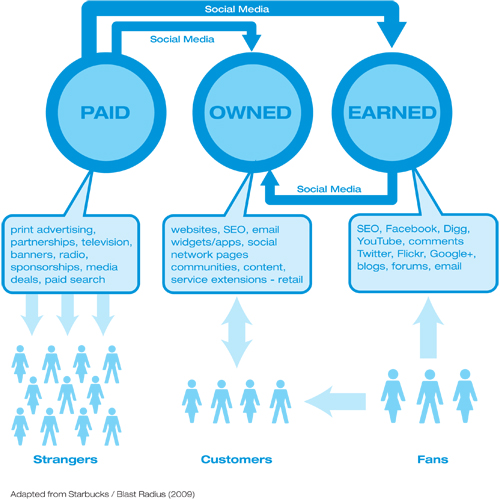
POEM stands for paid, owned and earned media, and all three types should be used by marketers to create a robust, integrated marketing plan. Each type has pros and cons and some forms of media can be leveraged more easily by some companies than others. The trick is to find a balance that works.

So what is paid, owned and earned media and how are they used?

Paid media

Paid media involves purchasing media – either directly or through an agency – such as sponsorship, paid search or advertising. A company will buy media space on someone else’s media ‘property’and promote their products and services accordingly.

The huge benefit of paid media is that it is easily accessible, giving any company the opportunity to broadcast and control their message within a particular channel (providing, of course, they have the money and resource to do so).

However, the drawback of paid media in today’s increasingly interactive and democratic mediascape is that paid media doesn’t offer the credibility it once did. Consumers are becoming more media savvy whilst relying on word-of-mouth recommendations and referrals from their peers.

Owned media

Owned media is where a company or brand controls the media channel, for example using a website, blog or presence on social media sites such as Facebook or Twitter (although this is probably better defined as partially-owned media).

I have always been an advocate for companies creating interesting, diverse and interactive websites precisely because this becomes their piece of online real estate from which a message can be tailored and controlled to reflect exactly what the brand is trying to convey.

Building an effective website takes a lot of time and effort but is nevertheless extremely cost effective considering the vast potential it can bring in the long term. In addition to this, a great company blog, co-ordinated with a relevant social media presence, gives brands the opportunity to reach out and form relationships with consumers by creating immersive, dialogue-orientated online experiences.

Earned media

Earned media was traditionally the remit of public relations, where ‘free’ media would be obtained through promotional efforts and editorial influence. However, earned media has since evolved, primarily as a result of the emergence of of web 2.0 and social media.

Earned media can therefore be defined as conversations, discussions and ‘buzz’ around a product or brand that is not being controlled by a single source but organically via a community or customer group. The idea is that a company earns the conversations of others by reaching out and giving people a reason to enthuse about them. The customer becomes the channel.

Although money isn’t exchanged, earned media isn’t free. Whilst you do not pay for placements within traditional media outlets you must instead pay in time, effort and resources and this is probably the biggest disadvantage of earned media for many companies. Earned media isn’t easy to achieve and for many paying for an advertisement is quick, simple and often easier to calculate ROI.

Nevertheless, the advantages earned media offers is vast. By listening and responding to consumers and generating positive word-of-mouth, transparency and credibility are at their highest and brings down the barriers between a brand and its customers generating goodwill and customer advocates. Great social media efforts can have a viral effect within online communities and beyond and live on after a campaign has ended.

Combining them all

It’s important for any brand to consider all three types of media and use POEM as part of an integrated media strategy. Paid media should be used along with dedicated owned media efforts to generate conversation among the customer groups and communities that matter.

Brands must take the time to discover the right places to interact with consumers on social media channels and encourage constituents to engage with them within owned media channels. It’s about finding the right people and giving them something to talk about.


Commitment

Commitment

This weekend I was in Clevedon in the South West of England to celebrate a quite brilliant achievement – my grandparents’ 60th wedding anniversary.

Besides having fun and catching up with family, I also felt this was a weekend of reflection. The idea of anyone doing anything for 60 years is mind-blowing and at times I felt in awe of what my grandmother and grandfather have achieved together.

I came away from the celebration thinking about the qualities and values that are needed to make a long-lasting, happy marriage and considered the parallels that exist with something I’m a little more familiar with – business.

Understanding

Over their six decades of marriage my grandparents have had to develop a clear understanding between them about everything from work, their roles within the household to family-related decisions. I doubt they’ve always agreed on everything but I am sure they’ve made sacrifices and compromises in order to make things work.

Businesses face similar issues regarding both the day-to-day running and strategic direction of a company. Successful companies are often set up in a way that allows different departments and functions to play their role in the running of the business whilst all the while understanding the the overriding objectives and goals that the business must achieve.

Teamwork

A key strength of a good marriage comes with power two people can bring when they work together to achieve a common goal. My grandparents have always supported and relied on one another through thick and thin and they wouldn’t have gotten where they have without each other.

Teamwork is about forming a cohesive bond and a unity in thinking and action. As with marriage, I have rarely seen or heard of a successful business that hasn’t involved good teamwork from the leadership team to the staff on the ground. It’s amazing what a group of individuals can achieve by working together to achieve a clear, common aim.

Commitment

I’m sure there have bee difficult times throughout my grandparents’ lives but one of the qualities they’ve always had is an unwavering commitment to one another and their marriage. Despite the many ups and downs they must have had, they’ve always stuck at it and it’s this quality that I’ve always greatly admired about them.

When I think of commitment in business I can’t help but think of leaders like Richard Branson, Warren Buffet and Steve Jobs (to name but a few!). All these guys were (and some still are) stoically committed to achieving their goals and seeing their visions realised. Giving up is something they have simply never contemplated and it’s this stubborn commitment that has seen them succeed.

Love

I think love is probably the word that best comprises all the qualities I’ve listed above and many more as well. Without a genuine love for one another it’s difficult to stay together and it’s this that has seen them through over all these years.

Love is something that rarely gets credited in business but I’ve always believed that unless you have passion, devotion and an abiding love for the work you do then true success and fulfilment will always be a touching distance away.


Discover the role of your social brand

Discover the role of your social brand

Social media has proved to be a great leveller, allowing any company to join in and be apart of the social web. The barriers to entry are low and as a result corporate use of social media is growing exponentially.

However, although it may be relatively simple to set up and create a social media presence, it’s another challenge entirely to craft a distinctive, defined and meaningful brand personality.

Based on the post ‘What is the Role(s) of Your Social Brand‘ by John Bell, I decided to visualise the various brand personalities a company can take on when participating in social media using platforms like Facebook, Twitter and Google+. The result is the infographic ‘Discover the role of your social brand’, brilliantly conceived and designed by Sally King at SK Graphic Design.

As John points out in his post, there are variations around each of the personalities and although the point is not to be tied to one single choice, the infographic hopefully reinforces the importance of being mindful of the role you play in social media.

Discover the role of your social brand

Please feel free to copy, share and distribute this infographic. All I ask is that you credit One Too Many Mornings and link back to this post.


The new Facebook Timeline: My first impressions

Gavin Llewellyn's new Facebook profile

On Thursday 22nd September Facebook held its 2011 f8 developer conference in San Francisco, California, an annual event with the aim of generating collaboration and networking between entrepreneurs and developers as well as announcements of new Facebook updates. With the introduction of Google’s new social platform, Google+, earlier in the summer, there was a lot of anticipation around this year’s f8 and Facebook CEO Mark Zuckerberg had a few interesting new features to share.

The Timeline

In addition to announcing that Facebook had (somewhat unsurprisingly) surpassed 800 million users and that apps will become more social, the profile page changes, and particularly the introduction of the new Timeline, was probably the stand-out new feature to be unveiled on Thursday.

Timeline is being sold by Facebook as a way to “tell your life story with a new kind of profile”. It’s like an online, interactive scrapbook allowing users to post updates, pictures, videos and links about what they’re doing now – and what they did, going all the way back to the day they were born!

Lifetream

Timeline works as a full lifestream of information and it will be interesting to see how many users populate their profiles with information going all the way back to their childhood.

Personally, I’m a little apprehensive about including pictures and updates on Facebook from when I was younger. Facebook may want us to include our whole lives in one place, but it might take me some time before I do.

Increased engagement with friends

Timeline will allow users to spend more time on their friends’ profile pages. As it currently is, I rarely visit a friend’s Facebook profile because I just read their updates when they come into my Newsfeed.

However, the Timeline element gives me an incentive to visit a friend’s actual profile page and see what was going on not just now, but two, three or even twenty years ago, too (assuming they update their Timeline that far back).

Gavin Llewellyn's Facebook profile page(2)

Visually impactful

The inclusion of a main ‘cover’ picture at the top of the page adds a real creative impact to a user’s profile and could be used as a ‘signature’ image along with the profile picture.

The two-column layout also adds a new dynamic to the page, with links, photos and videos creating a very visual and fun experience. However …

Busy interface

… there’s a lot going on all in one place. The scrapbook feel to the page means there are shiny photos here, an attention-grabbing link there, all of which results in a potentially cluttered space.

Jake Hamilton from Firebelly Marketing makes a good point when he says that there are comparisons with MySpace, in that all the flashy pictures and updates may become annoying to open profiles.

Privacy concerns

Following the roll out of Timeline, I would want the ability to filter content to certain friends in a similar way to how Circles work on Google+. I have different relationships with different people and the idea of everyone being able to go back in time and see what I’ve been up to is slightly disconcerting.

Timeline also reinforces a fact that many of us are already aware of: Facebook has A LOT of information about us!

Another step forward

Although it’s early days, one of my concerns is that the new updates may make the Facebook profile a little over-complicated, especially when you compare it to the simplicity and usability of Google+. Although some people have criticised Google for this, there’s surely something to be said for keeping things simple.

Nevertheless, it’s good to see Facebook taking things forward and continuing to innovate. The emergence of Google+ and their persistent pursuit of cracking the social space is encouraging both Facebook and Google themselves to constantly up their games and this can only be good for us, the users.

Note: if you don’t want to wait until the 30th September (when Facebook will introduce the new Timeline to everyone), you can always get a developer preview yourself by following these instructions.

What do you think of Facebook’s new updates? Do you like the idea of a personal Timeline?


5 super cool marketing websites

5 super cool marketing websites
Earlier in the year I blogged about the social media heavyweights I think YOU should be following. This included links to the blogs, websites, and social media pages of some of the biggest and brightest personalities in the world of social media.

But a recent post by Mitch Joel made me think about other marketing websites, besides out-and-out blogs and those based primarily around social media and digital marketing, that are particularly cool.

Many of the websites listed below could be considered to be blogs, but I’ve tried to pick out sites that are not primarily blogs and offer something a little more in terms of the variety of topics covered, writers are article type.

Marketing Wizdom

Website: marketingwizdom.com
Twitter: @marketingwizdom
Facebook: facebook.com/marketingwizdom

Robert Clay is the UK-based marketing guru behind Marketing Wizdom and his skill, experience and wizdom (typo and pun intended!) really shine through across the site.

The website incorporates a blog, specialist articles and strategy guides on a range of marketing subjects, as well as access to e-books, downloads and links to Marketing Wizdom on Facebook and Twitter. In fact, Robert Clay is one of my favourite people to follow on Twitter as he regularly curates and links to some brilliant marketing articles and blog posts from across the web.

The Next Web

Website: thenextweb.com
Twitter: @TNW
Facebook: facebook.com/thenextweb

The Next Web (TNW) is a site dedicated to the latest news, opinion, insight and gossip on everything web-related. With marketing becoming increasingly online-orientated, I consider TNW (along with other sites like Mashable and TechCrunch) to be a superb resource for leading industry insight.

TNW is also very useful for country, channel and subject-specific information. Stories and articles can be refined using the filter tabs on the left-hand side of the page allowing you to see the most essential information related to you or your business.

Smart Insights 

Website: smartinsights.com
Twitter: @SmartInsights
Facebook: facebook.com/smartinsights

Dave Chaffey, another trail-blazing UK marketing guy, is the owner and driving force behind Smart Insights, a website/blog dedicated to all things digital marketing.

I’m a big fan of the variety of posts Smart Insights publishes as well as the quality and knowledge the different authors have to offer. Each contributor is an expert on a particular subject area, for example email marketing, analytics, social media or SEO, and Smart Insights has consequently become one of my ‘go-to’ places for specialist marketing updates.

The Marketing Donut

Website: marketingdonut.co.uk
Twitter: @marketingdonut

The Marketing Donut  is one of many ‘donuts’ (including IT, Start-up, Law and Tax) dedicated to providing help, advice and resource to small businesses.

I really like The Marketing Donut because it strips away a lot of the jargon that often comes with marketing. Even as someone who specialises in marketing professionally, if I ever need to freshen up on a particular topic or learn about a subject area I haven’t dealt with as often I can always rely on ‘The Donut’ for clear, concise, straightforward advice.

Brand Republic

Website: brandrepublic.com
Twitter: @BrandRepublic
Facebook: facebook.com/BrandRepublicUK

Compared to many of the other marketing websites and blogs that I like, Brand Republic is much more of an online marketing newspaper.

As well as providing up-to-date insight on marketing trends and ideas, Brand Republic also has the latest news on marketing campaigns from big brands, the movers and shakers in the industry and a selection of excellent blogs from marketing experts.

What are some of your favourite marketing websites? Have you found any ‘hidden gems’ as well as the more widely known sites?