27 social media insights from SMM11

Our Social Times SMM11

On the 19th September 2011, I attended the Social Media Marketing and Monitoring 2011 (SMM11) conference in London, an event set up and run by Luke Brynley-Jones at Our Social Times. Unfortunately, I’ve not had a chance to attend many digital and social media events over the past year and so it was great to finally get opportunity to do so this week.

The event involved lectures, panel discussions and case studies on a variety of social media related topics, including the future of social networking, gamification and social SEO (to name but a few).

I learnt a lot from the event but here are 27 things that really stood out for me:

Social networking

1. Facebook users are starting to get ‘fatigued’. Our News Feeds are getting bloated and we are demanding increasingly more control over the content we receive.

2. Although many consider MySpace to be dead and buried, perhaps it still has a place as a ‘niche network’ (alongside Tumblr, Instagram, Foursquare and Posterous).

3. Google+ has potential to rival LinkedIn as a professional social network. The usability, design and functionality are superior to LinkedIn.

4. Twitter is likely to be around for many many more years and is not under the same threat as Facebook from new social platforms like Google+. Twitter’s openness, brevity and simplicity will continue to be very useful (consider the ability of the two-screen experience it provides users).

5. As soon as commercial interests start to take hold, there is an obvious change in the relationship between the users and the social network. MySpace suffered once News Corp took over and it will be interesting to see how Google+ fares once Google pushes advertising more aggressively.

6. Although any social network will appeal to different people for various different reasons, whether they’re established or emerging, functionality, popularity and potential will be the keys to growth.

7. Social media is approached differently across the world. For example, in China 48% of web users in are content creators, compared with 24% in the western world. This has huge implications for how social networks operate and the functionality they provide users.

8. Despite newcomers (i.e. Google+!), Facebook is still the dominant social network and will likely to remain so for the foreseeable future. There is still vast potential for growth and innovation.

Social media marketing campaigns

9. Engagement is fine, but it is leads, conversions and sales that ultimately count. A campaign’s effect on the bottom line is the best metric for success!

10. Integrate social media into the entire marketing communications mix – point-of-sale, television advertising, literature. Don’t just rely on a standalone Facebook page or Twitter handle.

11. Bring the campaign alive away from the online environment. For example, BMI Baby used Instagram as part of a social media campaign but have created a physical exhibition showcasing customers’ photography.

12. Agencies can be used to plan, run and execute campaigns but as long as there is appropriate resource customer interaction should always take place in-house. You are the ones that define and represent your brand personality and behaviour. Outsourcing engagement is like paying for someone to go on a date for you.

13. Whenever you use competitions as part of a campaign, allow the community to either select or be involved in the selection process of the winner. There is always a sense of cynicism and suspicion that the company or brand has chosen their winner.

14. Aim for longevity (and consistency) after the campaign has ended. A one-off campaign is a great opportunity to unite a community or audience but it’s a waste to let this go once it’s all finished. The goodwill, excitement and interest generated from the campaign can be used to carry things on afterwards.

Social media measurement

15. Beware of data paralysis. Sensible, meaningful and actionable metrics should be used to monitor and measure social media marketing activity.

16. Before any social media activity begins, always ask: “What are looking to achieve?”. Once you know where you’re heading the channels (including social media) can be layered on top.

17. Don’t silo social media insights. Be sure to share relevant information with other team members and departments throughout the organisation.

18. CRM – we’re used to asking for telephone numbers, age, dates of birth and even email addresses. But why not ask for someone’s Twitter name? More and more people are embracing social media so communicate with them in the way they want to be communicated with.

19. If social media is going to be used as part of your customer service efforts, ensure that someone always owns a problem. Making a ‘twicket’ (a customer service ‘ticket’ generated from a customer’s tweet) shouldn’t be sent downstream. Empower staff to deal with problems themselves.

Gamification

20. The number of ‘gamers’ is growing rapidly. Before 2008, gamification was niche and closed off. But now over 150 billion minutes are spent every month on social games, that’s an average of ten minutes for everyone on the planet!

21. Although many people are reluctant to participate in games (primarily because of trust issues), these barriers can be removed to open up the potential.

22. Gamification isn’t necessarily about ‘fun’. Consider how LinkedIn and surveys work: they tell you you’ve completed X% as a way of encouraging you to complete more to reach 100%. Everyone wants to win!

23. Four key questions to ask when considering gamification:

• What motivates the user/customer?

• What are the mechanics/rules?

• Is there social interaction?

• How do you win (victory conditions)?

Social SEO

24. There is differing (and conflicting) guidance as to the affects of Facebook ‘likes’ and Google ‘+1s’ on search results. However, research by Marcus Taylor from SEOptimse  has indicated that social sharing actions are having an effect on the indexing of websites.

25. Whilst the Facebook ‘like’ button did have an impact on search results earlier in the year, ever since Google’s Panda update and the emergence of Google+ it is primarily Google’s +1s and not Facebook’s ‘likes’ that are really impacting search results.

26. A key conclusion from Marcus’s research takes us back to what is nearly always the case: content is king. Good content = more ‘likes’ and +1s = more traffic. Each of these aspects can be leveraged to create a virtuous circle.

Social media continues to grow and evolve – quickly!

I gained an awful lot of insight from the SMM11 conference and also got the opportunity to chat and network with some very interesting people. However, one of the main takeaways from the day was a confirmation that social media is growing, changing and evolving at an insanely fast pace.

Oh, and there was one other interesting thing I learned at the event:

27. A new term I hadn’t heard before: ‘Social emphasis’ – the space between paid and earned media.

For a great account of the day check out Liberate Media’s excellent blog post. Also, slides from many of the presentations at the event are available at Our Social Times’ Slideshare page.

If you were at the SMM11 event (either in person or watching the live stream) please feel free to share any insights and learnings you gained from the day. Comments are always welcome! 


A drug dealer’s guide to inbound marketing

Drug dealers in the Mission by Javier Velazquez-Muriel

In their book ‘Re-Work‘, Jason Fried and David Heinemeier Hansson (who set up and run 37 Signals) provide a ton of fantastic advice and guidance for entrepreneurs, aspiring business owners and anyone looking to develop themselves and their careers.

As a blogger and inbound marketer, the book was a real wake-up call for me and one piece of advice that has stuck with me since reading ‘Re-Work’ was the authors’ suggestion to work and think… like a drug dealer!

Let me make it clear that I’m not advocating the consumption, distribution or dealing of narcotic substances! However, I admit that some of the methods drug dealers use to build their customer base is intriguing and that’s what I’d like to discuss.

Get ’em hooked!

Drug dealers get their customers addicted by first giving away either free or very cheap samples. A dealer knows that if the product is any good there’s a chance the recipients will become hooked and come back for more (at which point they can hike their prices whilst maintaining a steady flow of custom).

As marketers we can do something similar. By using blogs, social networks and other digital channels we can reach out to potential customers and draw them in with relevant, quality content around the subjects and issues they’re interested in. Instead of buying people’s attention through paid media, build an audience using earned media and get people to come to you. As you build a dedicated readership you can begin to develop a ready-made market who are switched on and interested in what you have to sell.

Go viral

If the product’s really good then word gets around and a drug dealer may soon find he’s got a huge upsurge in supply for the ‘next big thing’. The dealer’s getting more and more business for no additional cost – his customers are doing the marketing for him by sharing the product and through word-of-mouth.

Although we’re not promoting something chemically addictive (and potentially very dangerous), it’s still possible to create a buzz and get people talking by being creative, thought-provoking and outstanding in everything we do.

I’ve been following the work of Chris Brogan and Mitch Joel for a while now but I first heard of them through the blogosphere. Because they were (consistently) producing great content, people were recommending them to others on their own blogs and through social networks. As a result, they’ve both built up huge followings which have given them the opportunity to consult, sell books and attend high-profile speaking gigs.

Create something special

It’s pretty easy to set up a blog, Twitter handle or Facebook page and create content. But unless you aim to create remarkable work then it may all be for nothing.

With search engines like Google focusing on unique, quality content and the rise in social search, the old adage that ‘Content is King’ is becoming increasingly important. In order to cut through the clutter and engage audiences you really need to create something special.

Be confident in what you’re offering, produce engaging content and get it out there. Establish a genuine following – and deliver.

The next time you’re struggling to create a buzz around your product, think: “What would a drug dealer do?”


Developing the case for social integration

Social integration

Earlier this year Jeremiah Owyang presented a webinar (in association with Janrain and Badgville) on ‘How to Integrate Social into your Website‘. The webinar, based on research by the Altimeter Group, introduced a roadmap for social integration and explained how websites evolve as part of an iterative process.

In the webinar Jeremiah stresses the importance for companies to have a clear strategy for using social media as part of their digital marketing efforts. Far too often companies are being caught up in the social media ‘craze’ and creating multiple social media outposts without considering the need to provide a clear and engaging online experience for their customers.

A two-pronged approach to social networks

A key aspect of the research that resonated with me was the concept of of developing a two-pronged approach to social networks (see image above): the practice of producing content for multiple social channels (Twitter, Facebook, Google+, blogs) but aggregating this on the corporate website. This allows for a company to engage with customers in multiple social spaces whilst simultaneously presenting a collection of these conversations on their online property, i.e. their website.

Over the past 10-15 years a lot of investment has been put into corporate websites and this aspect of social integration minimises the effect of sending hard-eraned traffic and content away and instead looks to keep users engaged on the corporate website where companies have a greater opportunity dictating the customer experience and driving them to a point of conversion.

Creating trusted discussions

People trust their peers and this is a key reason why companies and brands are going to social networks such as Facebook. Trusted discussions among communities are taking place and companies understandably want to leverage this earned media.

Having designed, developed and cultivated an online user experience using the corporate website it is therefore potentially problematic to be sending people away to an external social site that you have either limited or no control over. Social sites and the corporate website should therefore be used in tandem to create a truly integrated social experience.

Case study: H&M

H&M have developed a ‘Social Media Room‘ that integrates social discussions in one key location within the corporate website.

H&M Social Media Room

The H&M Social Media room allows users to read, engage and interact with content within an H&M ‘zone’. What I like about this example is that users can filter the content based on the social networks they want to see content from.

What are your views and thoughts on social integration? Do you have any interesting examples and case studies to share?


A beginner’s guide to Facebook’s EdgeRank

invader cube by Jared Tarbell

Facebook is becoming an increasingly popular social media marketing tactic for many businesses as they look to take advantage of the 650 million+ user base the social network has built up since its launch in 2007. With 1 in every 13 people in world with an account, Facebook is by far the world’s biggest social network and is still growing fast at a rate of 10 million users per month.

However, setting up a branded Facebook page is not going to set the world alight and send the cash registers ringing unless you have a clear idea of how you’re going to use the page and where Facebook will fit in as part of your social media strategy.

To get young people to hit the ‘like’ button you need to give people a compelling reason to do so. But once they’ve done that you’ve still got another hurdle to jump: getting your content into their News Feeds. And that’s where EdgeRank comes in.

What is EdgeRank?

EdgeRank is Facebook’s algorithm that determines what content gets shown in a user’s News Feed. Different types of interaction (status updates, videos, pictures, links) are known as ‘Edges’, all of which are ranked in order of importance according to each individual user’s preference. Facebook wants to keep users engaged and visiting the site and to do that the most relevant content needs to be displayed in their News Feeds. Too much, not enough or irrelevant content could frustrate users and send them away – perhaps to a competitor like Twitter or Google+!

So EdgeRank is a very important tool for Facebook to keep things running smoothly for the people that matter – the users. Although the specifics of the EdgeRank algorithm have never been fully disclosed, Facebook has provided some insight as to the make up of the formula. There are three key elements:

Affinity

The affinity score is based on how friendly you are with someone (or something in the case of a brand page) on Facebook. The more you click on, view and engage with a person or brand’s content, the higher your affinity score is toward them.

The affinity score is designed to pick up on these signals of closeness and establish connections between users. Viewing somebody’s profile, commenting on their posts or checking out there photos are all signs of affinity.

For example, as a result of checking out photos of an old school friend (whom you’ve rarely had contact with either on Facebook or in real life) you may suddenly find that more of their photos begin to appear in your News Feed. That’s the affinity part of EdgeRank kicking in!

Marketing implications: Three simple words: content is king. It doesn’t matter how may ‘likes’ and fans you have, if your content sucks nobody is going to comment, like or engage with it and it will then be far less likely to get your messages into your target’s News Feeds.

Edge weight

Every interaction, type of content or ‘Edge’ is attributed a weighting. Facebooks wants users to stay on the site and interact with relevant for as long as possible (thus increasing the chance that users will share branded content, make a transaction or click on the revenue-driving ads to the side of the page).

Although there is no official ranking, it is widely understood that videos, photos and links have a higher Edge Weight compared to other things like basic status updates or likes.

But regardless of the amount of videos and photos you post, once again the quality of content is key. Facebook sees engagement as the most important factor when judging Edge Weight and therefore the number of comments each post receives is a leading indicator of how engaging a particular update is.

Marketing implications: Create content that is varied, interesting and most likely to generate engagement amongst your audience. Syndicating your blog posts or tweets will not cut it!

Time

Edges and interactions ‘decay’ over time. The newer the content, the higher it is likely to be ranked. Facebook wants the freshest news and updates to appear in users’ News Feeds and so time is of the essence.

Post content at times when your audience is most likely to be using Facebook so that it reduces the time decay and gets into their News Feeds.

Marketing implications: Frequency is important but it’s also important to be aware of when and how often your audience want to receive updates. There’s no point posting updates at random times of the day but it’s likely to be even more annoying if you decide to post lots of updates constantly!

Why EdgeRank is important for brands

It’s important for brands to understand what EdgeRank is and how it affects their marketing efforts on Facebook. It’s unlikely that fans of a Facebook brand page will go back to the page itself unless they are prompted to do so from content in their News Feeds, so establishing genuine affinity with customers is key to getting through to them.

For me, it’s all about great content. The Facebook brand pages I ‘like’ are ones that provide me with something new and different and encourage me to interact and comment. And I also like variety. If a page is just posting bland updates, I won’t be engaged. But a mix of photos, videos and interesting links are much more interesting.

For a more definitive guide to Facebook’s EdgeRank algorithm, check out this very good post from TNW or visit my Delicious bookmark page for further advice.


What does ‘engagement’ really mean?

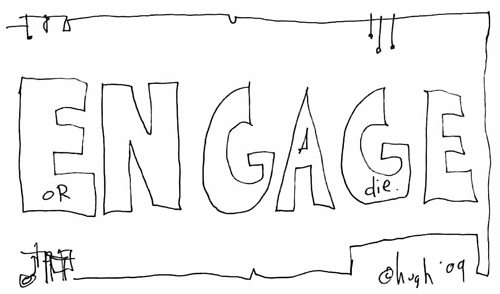
"Engage or Die" by Hugh MacLeod

In marketing and in social media in particular, the terms ‘engage’ and ‘engagement’ are used a lot. But what does it mean to ‘engage’ with people on the social web? And what does ‘engagement’ mean to customers?

Creating connections

Brian Solis defines engagement as ‘the time spent with the brand, either individually, in a community environment or through direct interaction’. In other words, engagement can be described as conversations with brand representatives (either individually or as part of a community) and/ or spending time and taking action with branded online content.

For me, engagement is about creating a connection with somebody else and in the case of companies and brands that inevitably means customers. To engage with a customer is to involve, excite and inspire them. Engagement is about establishing a bond with customers that breaks down the traditional barriers between vendor and buyer and begin to sow the seeds of a meaningful business relationship.

There are a number of ways to engage and create connections with customers. Some of the key ways include:

  • Conversations through social networks, blogs and forums
  • Comments on blog posts, websites and video
  • Bookmarking and ‘favouriting’ branded content
  • Fans, followers and likes on social networks
  • Interaction with online branded content
  • Traffic and activity around a website or social object
  • Downloads, registration and subscriptions to email, content, information and offers

Engagement is different to different people

Naturally, true engagement will differ depending on the company, its customers and their attitudes toward the brand. The goal is to successfully identify with your target audience and invite them to interact with you on their terms.

For example, to a young, dynamic fashion audience, engagement might involve community discussion around regular blog posts and Facebook updates related to the latest showbiz and entertainment news. Whereas engagement for customers in the retail sector might include subscriptions or opt-in to emails or alerts centred around offers and deals.

The key is to determine how your customers want to engage – and deliver.

Measuring engagement

As important as it is to define engagement, it is just as important to measure it. After all, what is the point of attracting hundreds and thousands of likes, followers and comments if you don’t know what this means to the business?

Companies intent on engaging with customers must consider who, how and where people are interacting with branded online content and how this relates to corporate objectives and performance. There must always be a strong, rational and conscious business reason for producing quality content and encouraging customers to engage.

What does engagement mean to you? How do you engage with customers? And how do you measure these connections and interactions?


What are you ‘about’?

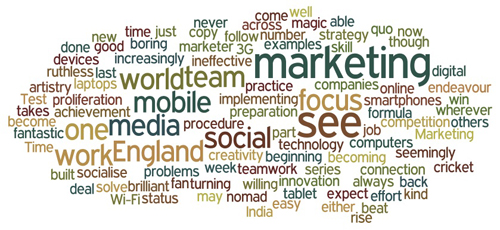
Gavin Llewellyn's blog Wordle for August 2011

When someone visits your blog for the first time what do they see? What type of content do you have? What are the topics you have written about within the last few days and weeks? And what writing style do you use?

Anyone visiting your blog will make a first impression within seconds of landing on the homepage and it’s during these crucial first moments that you need to capture the visitor’s attention and keep them on the site. And the key to doing that is to be clear as to what you’re ‘about’.

Who is your audience?

Before you even start blogging you should think about the type of person you are writing for. Consider who the typical reader of you blog is and try and visualise them in your mind.

If you’re a tech blogger they might be a twenty-something technology professional who’s interested in all the latest news and developments. Whereas if you blog about cakes and pastries your typical reader might be a student or young professional looking for new and innovative baking ideas for the weekend.

Consider the language and terminology your audience uses as well as any common industry terms. Although I’m not a big fan of jargon, I believe it does have a place when used correctly in the right time and place.

What are you trying to say?

The type of content you produce (text, infographics, podcasts, video) will allow you to communicate and get your ideas across in different ways.

Whilst a blog is traditionally text based, more and more blogs are including dynamic content to offer a variety of content. This not only provides your audience with a range of media to consume your content but is also great for SEO and accessibility, too.

What do you want to achieve?

Everything you blog about should be written for a purpose. And this doesn’t have to be business-related. If you’re blogging about a passion (writing, design, art) then you may want to achieve exposure for your ideas and become recognised by your peers.

However, if you’re blogging for your business then you will need to set some targets and goals related to the number of subscribers, followers and ultimately leads and sales you intend to gain as a result of your efforts.

What are you ‘about’?

The words you say, the manner in which you say them and the way in which you communicate will all paint a picture of who you are and what you’re about. The key is to be natural and to be yourself. Blogging takes time and the more you blog the sooner you’ll develop your own unique style and personality.

The Wordle word cloud at the top of this post indicates what my blog is about. What words would your Wordle pick out?