The Golden Circle: a formula for inspiring action

In 2010 Simon Sinek delivered a TED Talk on How great leaders inspire action, the content of which has resonated with me ever since. While most of us think nothing of how great companies and individuals get to (and often stay) where they are, Simon produced a lecture that offered a little insight into how the best inspire action.

It’s all about the ‘why’

In his TED Talk, Simon Sinek explains that many companies don’t consider, or at least communicate, why they do what they do.

Being in business for money should not be the ‘why’ (that is simply a result). Instead, the ‘why’ should be a much deeper, guiding purpose that everyone can believe in.

The Golden Circle

The Golden Circle is a simple framework that can be used to explain why some companies inspire action and why others don’t.

The Golden Circle by Simon Sinek

Whilst every company and person knows what they do (e.g. we make cars), only some know how they do it (the differentiating value proposition or USP) and very few know why they do what they do. The ‘why’ is fundamental belief and reason we exist and should be at the very heart of everything we do.

Simon argues that if you communicate from the outside-in then you are only competing on features, price and add-ons. But this is not inspiring and doesn’t give people a reason to believe in your product, service or cause.

Good leaders act and communicate from the inside-out. The process is reversed and they explain why they do what they do before talking about what they do and how they do it. For example, Apple do not start by saying they make great computers. Instead, the foundation of their communication revolves around their beliefs in thinking differently.

People don’t buy what you do they buy why you do it

What’s fascinating about the Golden Circle is that the concepts are all grounded in the tenets of biology and specifically the brain.

The Neo-cortex (the newest part of the brain) corresponds with the ‘what’ level and is responsible for all of our analytical and rational thought and language.

The Limbic System is the part of our brains that corresponds with the ‘how’ and the ‘why’ and is responsible for all of our feelings, including trust and loyalty. It’s also responsible for all human behaviour and decision-making.

Communicating from the outside-in lets people understand and compute vast amounts of information but crucially doesn’t drive behaviour.

However, communicating from the inside-out talks directly to the part of the brain that controls behaviour. This is where ‘gut’ decisions come from.

And why is it important to attract those that believe in what you believe?

The Law of Diffusion of Innovation

The Law of Diffusion of Innovation is a theory used to explain how a new product is received in the market.

The Law of Diffusion of Innovation

If you want mass market acceptance or success related to an idea you cannot do so until you achieve 15-18% market penetration. The early majority will not try something until someone else has tried it first and this is this tipping point that’s required in order to ‘close the chasm’.

It is the early adopters who are most comfortable trusting their gut decisions and intuitions based on what they believe about the world (and not just what product is available). Early adopters are the type of people that queue up for an iPhone when they could buy it much easier the following week. They want to be first and what they do proves what they believe in.

Define your ‘why’

Regardless of who we are, what we do and who we work for we should all define what we believe in and why we do it. Great companies, individuals and leaders know their purpose and communicate from an ingrained belief in why they do what they do and I don’t see why t’s any different for us.

There are two types of people: leaders (those that hold a position of authority) and those that lead (those that inspire us).

I know which one I’d rather be.


Extending your social strategy to your site

Evolution of the Social Corporate Website

Last week Jeremiah Owyang took part in a webinar in which he offered best-practice advice on how businesses should integrate social media within their corporate websites.

Some of the key take-aways from the webinar include:

The business case for social integration

  • Research proves that customers trust each other more than a brand’s messages. We rely on family, friends and product reviews to inform our decision-making
  • Research from Altimeter indicates that social integration within corporate websites is a key priority for many businesses
  • It’s therefore important for corporate websites and social channels to work in tandem with one another, not as separate entities

The viral loop

  • The Viral Loop framework (see image below) shows that a community will bring more people to your website over a period of time
  • This backs up the case for using social media and the corporate website together: don’t put all your investment into social networks. Instead, use them to bring traffic into your website

The Viral Loop

The evolution of the social corporate website

Jeremiah Owyang and the Altimeter Group have devised a roadmap with 6 stages to social integration (see top blog post image):

0. No integration

  • Basically, ignorance is bliss. In other words, websites in this category do not integrate social media into their websites at all and are therefore unaware (and unknowing) of the benefits integration brings
  • Trusted discussions about a brand are taking place elsewhere on the web and the corporate website is not reflecting this

1. Social linking

  • This is where a corporate website says “Follow us on Twitter” or “Like us on Facebook”
  • This is simply serving a social network. Although social linking encourages growth on a brand’s social channels, it is sending traffic away from the corporate website

2. Social publishing

  • This involves sharing mechanisms that encourage recommendations or referrals by triggering a ‘social alert’ as a form of endorsement
  • Examples include the Tweet and Facebook Like buttons, the latter utilising Facebook’s Open Graph

3. Social aggregation

  • This stage is about bringing content from a social network into the corporate website
  • This can be achieved through basic feeds (which is not recommended), curated or contextual content (where different content is aggregated depending on the nature of individual web pages)
  • The major benefit of this approach is that it is bringing trusted discussions into the corporate website so that the user has a much richer brand experience

4. Social context

  • This level is where users authenticate using their existing credentials (e.g. using social sign-on) and can therefore connect with friends or followers within the corporate website
  • The key aim is to get to a stage where a corporate website offers social + contextual content: content based on a user’s profile data and what their friends like!

5. Seamless integration

  • This level does not currently exist and is Jeremiah’s vision of the future!
  • Seamless integration is where users can no longer tell the difference between a social site and a corporate site
  • The advantage of getting to this stage is that it will allow a range of stakeholders to mix together on one site and accelerate the viral loop effect, thus brining in new members


The overall message to take away is that to effectively integrate social media into a corporate website you must have a clear plan and vision. For example, sites that are simply ‘social linking’ without a coherent strategy may be doing themselves more harm than good. In order to integrate social correctly you have to make an intentional step in the direction you want to go.

These are just a few brief notes so please watch the full webinar for a far more detailed and comprehensive look at all these aspects.


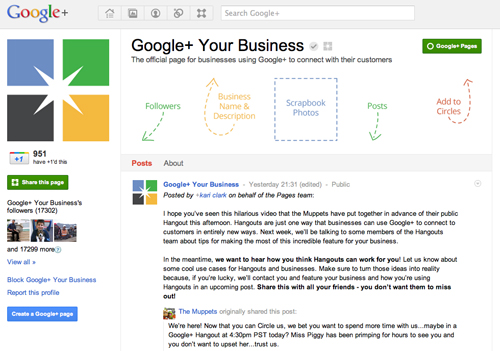
Google Plus Pages have arrived!

Google+ Pages have arrived!

After what seems like a very long wait since the initial launch of Google+ back in June this year, Google+ Pages have finally been unveiled.

Beginning today and continuing over the next two days, businesses will be welcome into the Google+ social platform by creating a Google+ Page using the Create a page tool.

I’m not going to explain much more about what Google+ Pages are (Google do a pretty good job of that themselves) or how to create a page (Danny Sullivan’s review for Search Engine Land does that) but I would like to cover a few initial thoughts that spring to mind following this new development.

What does this mean for businesses?

Businesses now have another social channel to consider in addition to Facebook, Twitter and their own company blogs. Some may see this as a hindrance but for those with a positive mindset they’ll see brand pages as a great opportunity to connect with customers on an exciting new social platform.

For sole traders and consultants already using Google+ I think it’ll be important for them to think carefully about creating a brand page for the sake of it. As with Facebook pages or a company Twitter feed a separate page needs to add value and offer something different.

A new dimension to Google+

With the launch of brand pages there is now a whole new dimension to Google+

As Google themselves mention, a lot of people feel a close connection with the companies and brands they love and brand pages will give businesses the opportunity to interact and engage with their customers.

I’ve always found Facebook pages rather clunky and as I pointed out in my first post on Google+ when it was launched, the style, feel and UI of Google+ is superior to Facebook’s and may well offer a better user experience for brand page fans.

A reason to visit Google+

Many of the critisms I’ve heard from sceptics is that there’s nothing for them on Google+ because all their friends are all on another social network (i.e. Facebook!).

If Google+ Pages can create something special for brands then customers, regardless of what social network they’ve pledged their allegiance to, may well be compelled to visit Google+ to join in the fun. And once they’re there? Who knows, they may well stay, create a profile of their own and invite their friends over!


It’s very early days but exciting ones nevertheless. The social media world is a flutter once again with talk about Google+ and the Google team have certainly stolen some momentum from Facebook following their announcements back in September.

It will be interesting to see how Google+ Pages evolve and develop in the next few months ahead but one thing is for certain: Google+ is well and truly here and they’re not going away!

What are your first impressions of Google+ Pages? 


Cool logos

The Hard Day's Night Hotel logo

I’ve always been partial to a cool logo. Whenever I see one I can’t help but enthuse about them! A well-designed, smart and interesting logo can be very inspiring and I have an awful lot of respect for the graphic designers, marketers and creatives that work on them.

The picture above is the logo for the Hard Day’s Night Hotel, a Beatles-themed hotel in Liverpool. I stayed there during my birthday weekend last week and had a great time (as a Beatles fan it really hit the mark!).

At first, I didn’t really understand what the logo was all about, only that it seemed strangely geometric and quirky at the same time. And then I stumbled across a sign that explained what it meant and it all fell into place.

The logo can be interpreted in a few of ways:

1. The logo is a depiction of the distinctive, opening chord of the song ‘A Hard Day’s Night‘. The dots illustrated in the logo represent where a guitarist’s fingers should be placed in order to play the G7 suspended chord

2. The logo could also denote the overhead Beatles stage plan, with Paul and George on the left, John on the right and Ringo at the back

3. The classic album cover design for A Hard Day’s Night features twenty squares, in the same way as the logo for the Hard Days Night Hotel

In my opinion, the logo is really just a representation of the opening chord for A Hard Day’s Night and the overhead stage plan and twenty squares observations are simply convenient (and clever) coincidences. But nevertheless, the logo works because it is uncomplicated yet thought-proking at the same time.

Although a logo is just one element of many that make up a brand, it still plays a very important visual role in the perception of what a brand is and what it represents. When designing a logo there are a number of rules to consider and the Hard Day’s Night Hotel logo follows (and breaks!) many of them.

What logos have caught your eye recently? Do you have any cool logo designs that you’d like to share?


How Coke is leveraging new media to add value

The media landscape is in a constant state of flux, continually shifting and evolving and brands are scrambling to learn, understand and take advantage of emerging channels and technologies.

Last week I stumbled across a couple of videos on Google+ that demonstrate how Coca-cola, one of the world’s top brands, is using social media, dynamic content and storytelling to develop engagement with key customer groups.

In both videos Jonathan Mildenhall, VP Global Advertising Strategy and Creative Excellence at The Coca-Cola Company, explains how Coke is looking to leverage the opportunities in the new media landscape to create an emotional connection with consumers and stakeholders.

Throughout both videos there are two key concepts to be aware of:

Liquid and Linked: The objective is to create ideas so contagious that they cannot be controlled (Liquid). These ideas are innately relevant to business objectives, brands and consumer interests (Linked) and through stories the aim is to provoke conversations and earn a discorporate share of popular culture.

Dynamic Storytelling: An evolution from one-way storytelling to the development of of incremental elements of a brand idea that get dispersed systematically across multiple channels of conversation for the purposes of creating a unified and coordinated brand experience (Dynamic Storytelling).

I hope you enjoy the videos as much as I did and take something away from the work Coca-Cola has been doing on creative and content excellence.


Why I’m falling in love with Instagram

The Pembrokeshire Coast by Gavin Llewellyn

I use a lot of social networks for a variety of different reasons and yet there is a relatively unknown, mobile-based social network that has caught my attention – and imagination!

Instagram is an iOS-only photo sharing app with a difference: it allows you to apply a series of different filters and effects to your pictures, turning them from seemingly throw-away snaps into beautiful, retro-themed masterpieces. Chris Brogan recently joked that “it’s like turning your insignificant photos of your life into instant album covers for fake albums”.

I’ve really taken a shine to Instagram and I’ve got a few thoughts as to why it’s proving to be a winner with others, too:

A richer social experience

Since joining Instagram and building my network, I’ve found that it’s more than just about posting photos. As with any successful social network, Instagram works because of the community and associations you make with other ‘Instgrammers’.

The act of starting and joining conversations based around interesting and thought-provoking photographs has given me a richer social experience. Photography is a very emotive medium and it feels very rewarding to see that someone has commented on or ‘liked’ something that you’ve created.

Connect with new people

By checking out what other people in my network are ‘liking’ and commenting on as well as what’s ‘popular’ on Instagram, I’ve found a whole host of new people to friend and follow.

I often follow people on social networks based on what they write yet Instagram allows me to follow people based on the photos they post. This adds a new dynamic to the social experience and allows me to connect with people based solely on the photos they create.

Reach out to other social networks

As well as sharing pictures with your Instagram network, the app also allows you to share your pictures with your extended network of friends on Facebook, Twitter and Flickr, too.

This is a great feature because in addition to giving Instagram increased awareness across other platforms it also allows you to share what you’ve created with others who are not part of Instagram.


Instagram works because it is fun, simple and gives people a reason to keep coming back, i.e. to create more interesting photos and see what others have produced, too. I’m not a photographer but Instagram makes me feel as though I am and that’s a lot of fun!

By creating a different, mobile-only photo sharing app Instagram has created a niche social network that stands from similar sites such as Flickr and Picasa. It will be interesting to see how Instagram evolves and develops and I’d like to see it rolled out across other operating systems so that the network can grow.

Do you use Instagram? What do you like (and dislike) about the app? And what do you think is it potential?