Should Twitter feeds be handled by third-parties?

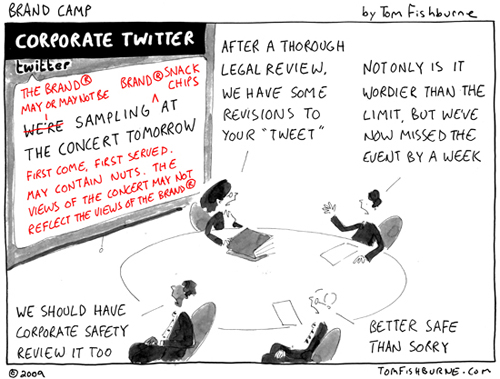
Corporate Twitter by Tom Fishburne

There have been some high profile incidents recently involving celebrities and Twitter, notably Alec Balwin’s fracas with American Airlines and Ashton Kutcher’s decision to hand over the running of his Twitter feed to a management company.

And brands have also run into problems, with faux pas from Habitat, Kenneth Cole and Qantas all springing to mind.

As a result of episodes like these, the question as to whether Twitter feeds should be managed by third parties, such as PR firms and marketing agencies, has been asked again in both the blogosphere and mainstream media.

The case for using a third-party

Conversations and exchanges on Twitter are instantaneous and happens in real-time. Whilst this is what makes Twitter so good, it can also be the downfall of hot-headed celebrities who forget to think before they tweet.

A third-party can act as a buffer between a celebrity and their fans. This means that when a debate flares up or a big event occurs there is someone else carefully managing the process (and hopefully in consultation with the celebrity to maintain a degree of authenticity).

A third-party can also help brands manage their social media marketing efforts. Social media is still a relatively new phenomenon for many companies and a specialist agency or marketing company can help facilitate the process and ensure that social media is managed and executed effectively.

The case against using a third-party

Twitter offers people the opportunity to interact and connect with celebrities in a way that is not possible using traditional media. The feeling of intimacy a fan can get from following a footballer, movie star or business tycoon is completely dependent on the authenticity of the ‘star’ in question.

By using a third-party you are essentially putting a barrier up, thus reducing Twitter to yet another broadcasting mechanism. The real value of Twitter lies in the art of engaging with followers, starting a dialogue and building relationships.

Although the situation is a little different for companies, I believe the same basic principles apply. Outsourcing social media is a tricky balancing act and although some consumers may be happy to follow a brand on Twitter to get deals or special offers, authenticity and a careful appreciation of the medium is still essential to ensure that any exchange or interaction is handled appropriately by the company.

It’s a judgement call

The decision as to how a Twitter feed should be handled is completely dependent on the brand or celebrity involved. As with most things in social media, there is no clear right or wrong way of doing things.

However, Twitter is a unique platform that allows you to make genuine connections with anyone, anywhere. Delegating tweets to a third party leaves you disconnected from your followers and creates a diluted version of the whole experience.

Whatever you do, the key is to be honest and transparent so that your followers know who they are really engaging with on Twitter.


5 top LinkedIn groups for marketers

Linkedin Chocolates by Nan Palmero

With all the fuss over the continued rise of Facebook and the emergence of Google+, LinkedIn is often overlooked. But as a social network for gaining knowledge, information and new insights LinkedIn can be great.

One of the best aspects of LinkedIn is the groups. Whilst many often start with a bang before slowly fading away, those that stick around can become bustling communities where smart, like-minded users can discuss their topics and niches in detail with each other.

So which are the best groups on LinkedIn for marketers? Here are my 5 suggestions:

Marketing Over Coffee

Join the Marketing Over Coffee LinkedIn group

Marketing Over Coffee is one of my favourite marketing podcasts and it’s not surprising to find that the team’s LinkedIn group is very good, too.

The group encourages discussions related to digital, online and traditional marketing as well as conversations around the latest technological developments in the marketing world.

The group also has a set of very good group rules to keep users in check and keep spamming to a minimum.

Smart Insights

Join the Smart Insights LinkedIn group

If you’re interested in search marketing, web analytics and digital marketing case studies then head on over to the Smart Insights LinkedIn group.

The group encourages any marketer, regardless of their experience, to join in and start discussions and as a result of this there is a good variety of topics and posts.

Harvard Business Review

Join the Harvard Business Review LinkedIn group

Although the Harvard Business Review LinkedIn group isn’t specifically about marketing, it is nevertheless a group that any marketer serious about their craft should stop by and join.

The group offers a rich, versatile mix of discussions that range from entrepreneurship to the art of people management, to innovation and advice on how to ace a job interview.

Mashable

Join the Fans of Mashable LinkedIn group

As one of the world’s pre-eminent online sources of breaking news, features and analysis on everything related to marketing and the web, the ‘Fans of Mashable’ LinkedIn group is a natural extension to the website.

In this group you’ll find discussions focused more specifically on digital marketing and technology, for example blogging, email, social media and mobile marketing.

SEOMoz

Join the SEOMoz LinkedIn group

The SEOMoz blog provides advice, tips and tricks for search engine optimisation and the LinkedIn group is also predominantly SEO-focused.

However, with the continued growth of social media and its impact on search, the group also hosts discussions related to how social content, blogging and social networking are impacting search marketing efforts.

What do you think of the groups I’ve listed? And would you recommend any other marketing-related LinkedIn groups?


What good branding is really about

Following his death in October earlier this year, many blog posts, articles, tweets and videos were shared by millions around the world about Steve Jobs and the work he did.

Some of the best videos included Jobs’ 2005 Stanford University commencement speech as well as his double-act with Bill Gates at the D5 Conference in 2007.

But one of the videos that really stood out for me was of a presentation Steve Jobs made to Apple employees following his return to the company in 1997.

If the video above is not working you can view it right here.

Although the presentation revolved around the launch of the ‘Think Different’ campaign, the content of Jobs’ presentation in the seven minute video is not only inspiring but offers one of the best explanations of how good marketing and branding works.

Last month I talked about the Golden Circle and the importance for companies – and individuals – to focus on why they do what they do. It is the core values and beliefs of a brand that inspire others to take notice and follow.

Steve Jobs was fully aware of this when he returned to the business he founded after a ten-year absence. During his time away Apple had lost sight of what it really stood for but Jobs was about to re-focus and set the company on a path that would eventually make them the most valuable brand in the world.


Focus on the social networks that work for YOU

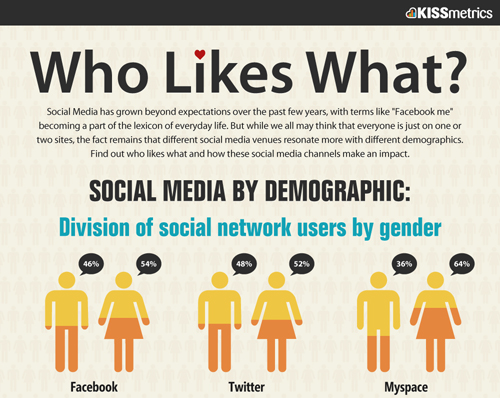
Who Likes What: Social Media By Demographic

Facebook, Twitter, LinkedIn, Google+… there are so many social networks but where should you be focusing your efforts?

Go where you customers are

With Facebook being all the rage one minute, Twitter the next and most recently Google+, it’s easy to think that you should have a presence on all the social networks that are currently out there.

But whether you work for a small company or a team within a larger corporation, the chances are your resources are limited. It’s therefore very difficult to exist and make a valuable contribution on every social network.

It’s important to be selective about the social networks you choose to participate in. One simple way to limit the scope of choice is to research and identify where your customers are hanging out online. Meet the people you want to start a dialogue with on their terms in their social networks.

Turn up and add value

Many businesses using social media are spreading themselves too thin across too many social networking sites in the fear that they might be ‘missing out’. As a result, you’ll often find ‘social media ‘ghost towns‘ – where a page or site has been set up and started only to be abandoned for ‘something more important’. This does nothing for either the customer nor the company’s online image and reputation.

The statistics and figures from a KISSMetrics infographic (featured at the top of this post) indicate that there are general differences in how social networks are being adopted and used by different demographics. And there will be even more striking differences in how social networks are being used specifically by your customers and constituents.

The key is to set up a presence on a select few social networks where you can turn up and add value on a consistent basis. By focusing your efforts and sticking to an agreed plan of action you will be much more likely to reach your goals and objectives using social media.


30 ways to get more targeted traffic to your blog

Macet by basibanget

This post was originally published on Smart Insights on 22nd November 2011. I cross-post it here with all the links and tags for your reading pleasure!

Seth Godin’s best post for the blogger revisited

A few years ago Seth Godin wrote a great post on how to get traffic for your blog. Seth listed a number of excellent ideas and techniques that any blogger can use to generate interest, attention and advocacy for their blog.

Six years on and many of Seth’s traffic-generating tips are still very relevant today. However, a few things have moved on so I thought I’d re-visit the post and pick out some of the best tips for getting more targeted visitors to your blog.

1. Be topical and write posts about things people are interested in TODAY!
2. Become the thought leader and expert in your field so that people rely on your insights and opinions.
3. Be among the first with a great blog on your topic, then encourage others to blog on the same topic.
4. Have an opinion. Be controversial and dare people to respond (with links back to you) on their blog
5. Interview interesting and well-known people.
6. Use lists!
7. Have a distinctive, unique and well-designed blog
8. Don’t write about your cat, your boyfriend or your kids. Or do so. Just make it interesting!
9. Tag your posts. Use delicious.
10. Coin a term or two. Not so easy to pull off, but the originators of “Conversion rate optimisation”, “Inbound marketing” and “Permission marketing” managed it!
11. Write about Facebook, Google, Twitter and blogging.
12. Be the first to announce and break news.
13. Focus on a niche that appeals to an obsessed minority.
14. Encourage your readers to Digg, Tweet, Like and +1 your posts. Do it with every post.
15. Use photos. And post them on Flickr.
16. Educate your readers.
17. Include comments so your blog becomes a discussion zone that generates conversation.
18. Write linkbait headlines. Or is this Sharebait?
19. Be generous with your expertise so that people recognise it and depend on you.
20. Write about things that appeal to the majority of current blog readers, for example gadgets, social media and Apple.
21. Be timeless and write posts that will be relevant and useful in one, two, three year’s time.
22. Don’t interrupt your writing with lots of links.
23. Edit yourself. Ruthlessly.
24. Digest the good ideas of other people, all day, every day and let this influence your writing.
25. Research the days and times when your audience are most active and post then to maximize readership.
26. Write about a variety of different topics so you keep your readers interested and coming back for more. Or…
27. …become definitive and write about one thing – in detail.
28. Don’t promote yourself, your business, books or projects at the expense of the reader’s attention.
29. Don’t be boring!
30. Write great stuff that people want to read… and share!


Social media success is more than just a number

Happy Pi Day (to the 36th digit)! by Mykl Roventine

Last week Jeremiah Owyang blogged about why the number of fans and followers you have is NOT a business metric – but what you do with them is. The post reminded me of a couple of conversations I’ve recently had with marketing directors of well-known online brands. Whilst they were keen to use social media as part of their marketing mixes, both seemed more focused on the number of fans and likes they could accrue rather than the action they would take with their followings.

Bigger is not always better

A large following, whether that be Facebook likes, Twitter followers or the number of people and companies in your Google+ Circles, is a perfectly legitimate social media marketing metric. Amongst other things, a large following will give you an opportunity to market to those followers as well as help you establish social capital. But I don’t believe this should be your most important social media marketing metric.

It may sound like a cliché, but quality really is more important than quantity when it comes to effective social media marketing. You may grow your following and boast over a million likes on Facebook but so what? Unless you do something with those followers then it just becomes a collection of numbers.

Social media requires a different type of thinking. It involves bringing the audience into the marketing process by including them in conversations and engaging with them. Social media marketing will not be effective if you build up a following only to broadcast messages and advertisements to them. It’s important to proactively target your key social media audiences and give them a compelling reason to connect with you.

It’s not just the size – it’s what you do with it that counts!

A million Facebook likes would be great but what if only a small percentage genuinely liked you and the majority were disengaged and unresponsive to the discourse you’re trying to generate?

Surely it would be better to aim for 20,000 Facebook fans who are interested and enthusiastic about you and forms part of a community that regularly interacts with your content and spreads it organically across their social graphs. Only this way will you begin to see increased traffic and conversions.

As with any aspect of marketing, social media should be intrinsically linked to the overall objectives a business is looking to achieve. This could be creating brand awareness, improving customer service or generating leads and sales. These are the metrics that matter the most.

What are your thoughts on social media marketing metrics? What do you use to measure success? What does good social media look like?