Google+ best practice from Cadbury and H&M

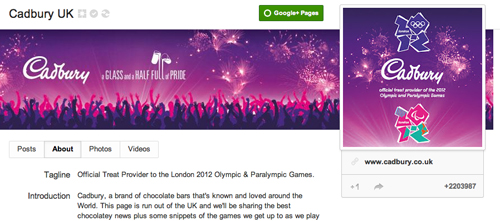
Cadbury on Google+

This post was originally published on Smart Insights on 9th August 2012. I cross-post it here with all the links and tags for your reading pleasure!

Despite celebrating its first anniversary earlier this summer, Google+, the search engine giant’s flagship social networking platform, is still a relatively new concept for many brands.

Although brand adoption of Google+ is way behind other social networks, notably Facebook and Twitter, some businesses have jumped in and are making waves to stir up interest, engagement and interaction with their fans on Google+.

But what is the secrets to their success?

Confectioner Cadbury UK and clothing brand H&M are leading the way with their Google+ pages and are utlising the network to great effect.

Here are five best practice Google+ tips from two of the network’s leading lights:

1. Know your audience

Before jumping into Google+ it’s important to have a good idea of your customers and audience beforehand. Every social network is different and each has its own idiosyncrasies so ensure that you build a platform that connects with your customers.

One way to begin gaining insight about your audience is to listen out for what people are saying about your brand, your products and the wider industry as a whole. What are people talking about? Is there a discussion already taking place that you can tap into?

To start listening, start searching. Make use of keywords and hashtags to see what’s being said and what’s trending. Cadbury actively listens to feedback from users and proactively engages in debate and discussion.

2. Have a strategy

As with brand activity on any social network, the key to success is to have a clear strategy as to how the network will be used.

H&M’s Google+ strategy is to take advantage of the visual nature of Google+ to offer big, bold photography to inspire users and ignite discussion. H&M’s followers are very engaged with fashion and H&M use their brand page to lead discussion around this area.

Cadbury’s Google+ strategy is to connect with their customers and build a community of brand advocates. By regularly sharing stories, pictures and videos, Cadbury have been able to engage their followers around their product ideas and have been able to launch products exclusively on Google+. This is their online value proposition for this channel.
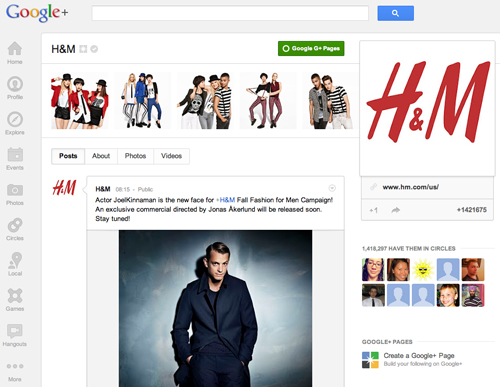
H&M on Google+

3. Build a community

One of the things Cadbury has done so well is to mobilise a strong community around the brand and its products. They haven’t just built up a group of followers for the sake of it. Instead, they’re using posts to tap into an engaged community that can respond to questions and ideas from the Cadbury team (e.g. the exclusive product launches).

Cadbury has also exploited Google+’s unique functionality, Circles.

Cadbury uses Circles to give followers specific, tailored content that they want as well as using them to engage in specific conversations with small groups on the page. They’ve actively asked people what Circle they’d like to be in and added them individually.

This process, whilst time-consuming, is good for Cadbury as it gives them the opportunity to get to know their customers better and segment them accordingly.

4. Be visual

Google+ is big on pictures and brands can use this to their advantage. The ‘What’s Hot’ section on Google+ is dominated by photography and visual topics and it’s clear that great imagery cuts through and engages Google+ users.

H&M integrates their Instagram activity (the photo-sharing app recently bought by Facebook for $1 billion!) into their Google+ page to promote their work and consistently use photography to interact with fans around new product launches, fashion ideas and surveys.

Cadbury on Google+

5. Measure

With any kind of marketing activity it is of course essential to monitor, track and measure performance. And a brand’s presence on Google+ is no different.

Whilst Google+ does not offer a bespoke analytics package, Ripples can give brands an indication of what type of content is being shared and by whom. As of course, +1s, re-shares and comments can also be used as indicators of what content is working best for users.

Brands can also use a range of link shorteners and third- party Google+ tools such as Zoomsphere to track growth, click-through rate and engagement with users. The benefit of using public tools such as these is that companies can also keep an eye on competitors efforts, too!



What we can ALL learn from Olympic champions

Celebrating the Olympics at the BBC in Manchester

Like millions of others all around the world, I’ve been captivated by the London 2012 Olympic Games. As a Briton, I was always looking forward to this year’s event more than all the others and it hasn’t failed to live up to expectations!

After the splendid spectacle of Danny Boyle’s wonderfully directed opening ceremony, it was soon time for the real action to start: the sport!

As I continue to watch the different events and the athletes who continually make me wonder in disbelief by their achievements, I’m also trying to learn what I can from the elite performers, trainers and coaching teams on show at the Games.

Although I’m not an elite sportsman, I’m trying to learn what I can from the world’s best athletes and gain some inspiration from what they do in order to reach the top of their game.

Plan for success

I’ve been really taken in by the achievements of the British cycling team. Ever since the Beijing Olympics four years ago, they’ve been going from strength to strength and despite rule changes to stifle their dominance they’ve been just as successful at this year’s Olympic Games.

In their 2009-2013 strategy, British Cycling states that in addition to improving British Cycling’s chances in the London 2012 Olympic Games and inspiring people to get on their bikes, they want to create a British winner of the Tour de France within five years. They achieved that goal within four.

The takeaway:

Without a clear plan, SMART objectives and a commitment to achieving those goals, success will be difficult to obtain. The route to success is paved with many obstacles so a solid vision and action plan is key to ensuring you reach the right destination.

Bradley Wiggins at the Road Cycling Time Trial by The Department for Culture, Media and Sport

Perfect practice makes perfect

When I was learning to play tennis as a youngster, I was taught that it isn’t practice that makes perfect – but perfect practice. And this is a philosophy all top athletes practice in order to gain an advantage over their rivals.

I have no doubt that every athlete at the Olympics has put in years and years of brutally hard work to get to where they are. But it’s important that they’ve been training in the right way to become as effective as possible at their chosen sports.

The takeaway:

Top Olympic athletes work with teams of professionals (trainers, psychologists, nutritionists) to ensure they practice and train as effectively as possible. And the same goes for any of us in our chosen professions. There’s no point working excessively long hours if we aren’t working on the right things, in the right way.

Commitment and determination

In order to train, practice and work at your craft to be the best, you have to want to do it. You have to really want to do it!

A genuine determination to be the best in the world, and the belief that goes with it, is something champions do in order to effectively commit to the work they need to do to reach the top.

In sport there are highs – but also many, many lows, especially during the long, cold winter months. During the tough times it’s important to remain focused on your goals and remember what the prize is for all the work: the chance for gold medal success!

The takeaway:

To get to the top you need to believe you can get there and have the right positive attitude to do the work to do it. Without that inner desire the work will seem harder and success always touching distance away.

Mental strength

When two equally skilled and physically equipped elite competitors face off against each other, what can possibly separate one from the other?

In addition to possessing the right physical strength and skills, Olympic champions must also have the right mental attitude and psychological approach to gain a competitive edge.

Great competitors often have a philosophical approach to their sport, too. They often talk about ‘moving on’ after a defeat and remembering that there is more to life than sport. This is allows them to really focus on what they do when it matters and then switch off afterwards, preventing burn-out whilst still maximising performance.
Space
The takeaway:
Space
It’s important to put everything in perspective. Whilst winning (or achieving ‘success’) is the goal, it’s not the ‘be all and end all’. Top athletes re-focus after failure and learn from their mistakes and we can do exactly the same when we miss our targets.
Space 

Canoe slalom by The Department for Culture, Media and Sport

It’s all about doing the work – hard work

What underpins all the points mentioned above is hard work.

During nearly every post-race interview I’ve seen during the London 2012 Olympics, the winners – and losers – have talked about the hard work that they have put in prior to the competition. There’s no talk about innate talent or divine inspiration, just good old-fashioned hard work.

What separates the best from the rest is preparation, training and phenomenal hard work. And I believe the same is true for those outside of the sporting world. I know that if I want to be the best in my field of expertise, I have to put the time in to work at the things that matter most.

The takeaway:

Nothing in life worth having comes easy and it takes hard work and a whole lot of effort to get it.

Without putting in the work you will always fall short because one thing’s guaranteed, there will always be someone else working harder than you elsewhere!


Generating quality inbound links for your website

Links by Ian Mackenzie

Getting found online is still a top priority for both big and small businesses alike. Google research from last year indicates that up to 70% of buyers use search at some point in their research journey.

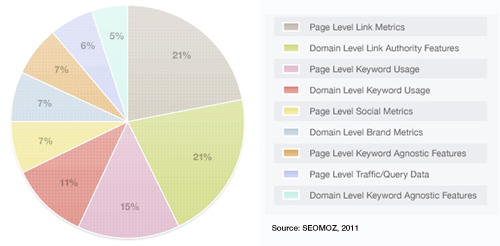
Despite numerous algorithm changes and the more recent influence of social signals, generating quality inbound links to your website is still the primary ranking factor for appearing prominently within organic search results.

SEOMoz ranking factors

Google (other search engines are available, although Google is still very much the dominant player) regards a link from one site to another as a ‘vote of confidence’. If someone is willing to link away from their site to yours, then the assumption is that your content must be worthwhile to that user.

However, some webmasters are still intent on buying links to their website in an attempt to ‘game’ the system. Whilst this was a genuinely effective ‘black hat’ SEO tactic ten years ago, it doesn’t work quite so well now and can even incur the wrath of Google should you get caught!

Focus on quality links that add value

There should be a focus on earning quality, ‘hard’ links – as opposed to ‘easy’ links (that can be easily obtained or bought). And there should be emphasis on the word earn. The aim should be to earn links from places where there’s a real audience that might see your link and click on it directly to visit.

Good links should add value to the reader. They should be meaningful and complement the content the reader is already consuming. Effective link-building is about quality, not quantity.

As social media activity continues to impact organic search results, there is more scope and opportunity to obtain quality links from a variety of sources.

So, what tactics can you use to generate contextually relevant, quality inbound links from other websites? Here are a few ideas:

Create consistently high quality content

Content should be unique and provide real value for the reader. The days of writing posts that are stuffed with keywords and make very little sense have long gone.

Great content doesn’t have to be written content, either. Examples of great content types include:

  • Infographics
  • Case studies
  • Articles
  • E-books and guides
  • Video
  • Photos
  • Presentations

Common across all these content types should be an emphasis on your target customer and an appreciation of what works for them. For example, if your research suggests your customers are very visually-oriented, infographics, photos and video may be more effective than detailed case studies or white papers.

To make the content high quality, efforts should be made to produce work that is unique (not scraped from other sources), engaging and resonates with the target audience to the extent that they’re compelled to link to it and/or share with their social networks.

Contribute to other blogs

As well as producing content of your own, there is great value in participating and contributing to other people’s work, too.

Consider blogs in your niche and sector and engage in meaningful conversation. Leaving comments has two benefits:

1. The comment will include keywords and often a link back to your website

2. Readers of those blogs will see you as a genuine authority/ thought-leader in your area of expertise

A step further would be to offer to guest blog. Guest blogging allows you to write naturally keyword-rich content on your areas of expertise, with links back to your website, on a website or blog that is contextually relevant to yours.

Submit your site to directories

Directories used to be a very popular form of link-building, primarily because they were actually used by people for finding websites.

Whilst directories are less popular now (because of search engines!), it’s still worth submitting your site to directories but only if they have real traffic, people use them and they have human editors (who select sites on their merits).

Get social

Join social networks where your customers are hanging out (but don’t set up an account on Twitter or Facebook for the sake of it) and create experiences that people will benefit from and enjoy.

Sharing great content on social networks will allow people to find, read, share and link to your content, as well as submit it to social bookmarking sites such as Delicious Reddit and StmbleUpon, too, generating inbound links for your site.

It’s also worth considering setting up a Google+ account. Whilst I would always encourage people and businesses to join social networks that are most relevant for their customers, there are a number of SEO benefits to joining Google+ that are certainly worth considering.

Don’t forget the anchor text!

Wherever possible, it’s important to optimise the text used within the inbound link. The anchor text strongly influences rankings and it’s worth writing SEO-friendly text that is both succinct and relevant to the target page wherever possible.

Whilst it will be very difficult to optimise the anchor text for all inbound links (you don’t have control), it’s nevertheless worth asking sites that have linked to you to consider what they write when linking back to you.

I know I have only scratched the surface of options for generating quality inbound links to websites but hopefully this will give you an idea of where to start. If you have any other ideas, tactics or strategies please feel free to share them here!


How to win the internet with inbound marketing

A Unified Strategy For Search And Social Dominance

The democratisation of the web has opened up new possibilities for marketers, allowing businesses the opportunity to reach new prospects and develop relationships with customers in ways that wasn’t possible only a decade ago.

Inbound marketing gives companies – big and small – the opportunity to use a range of ‘free’ marketing tactics to target people already learning and researching about a business, it’s brand, products and services. With a bit of hard work, creativity and nous, savvy marketers can reach interested prospects by earning their attention rather than interrupting them using outbound marketing tactics.

Why inbound marketing matters

One of the fascinating aspects of inbound marketing is how many of the different disciplines overlap with one another. Social media, search engine optimisation (SEO) and content marketing overlap and feed into one another.

In order to earn people’s attention you have to create great work that gets noticed. The common denominator is that all inbound marketing tactics can be used to raise awareness and to develop stronger connections and relationships with people.

Get found online – and get consumers’ attention

Two key tactics of inbound marketing include SEO and social media.

In this new Slideshare presentation, I’ve looked specifically at how SEO and social media can be used together to create a strategy where customers’ attention is earned through great content.


Whilst SEO is used to get found online, social media can help develop engaged communities on a company’s website as well as on various external social platforms. Content marketing then acts as the ‘glue’ that binds SEO (generating quality inbound links) and social media (telling the brand’s story).

Win the internet using an integrated approach

Natural search has evolved considerably over the last 3-4 years and with the introduction of social signals and an increased emphasis on quality content, social media is beginning to impact traditional SEO on a much larger scale.

This presentation is therefore designed to look at how inbound marketing can be used in an integrated way both strategically and tactically to win people’s attention and garner relationships with interested customers.

Inbound marketing is not a short-term tactic. It takes time and effort. But the rewards for getting it right are long-term and will benefit both companies and customers alike.


Make good art

One of the joys of YouTube is the access to brilliant speeches and presentations. As well as TED Talks and conference keynotes, I enjoy watching and listening to great commencement speeches, too. In twenty to thirty minutes I regularly come away feeling enlightened, motivated – and a whole lot smarter than I did before!

One of my favourite speeches is Steve Jobs’ 2005 Stanford Commencement Address. Although this isn’t a particularly original choice (at the last count the video had nearly 15 million views) it’s nevertheless a wonderful speech that captivates and inspires in equal measure.

I recently stumbled across another great commencement address, this time from the writer Neil Gaiman at the University of the Arts.

Whilst I’ve never read any of Gaiman’s work, I am familiar with what he’s done and I’ve watched a couple of film adaptations of his stories – Coraline and Stardust.

Gaiman’s commencement address is understandably different to Jobs’ yet it’s similar in its tone and insight.

Whilst Jobs encouraged us to trust in something, follow our hearts and intuition and stay hungry and foolish, Gaiman encourages us to enjoy the moment, make mistakes, break the rules… and make good art.

Neil Gaiman and Steve Jobs may have been poles apart in terms of who they are and what they’ve done. But they are frighteningly similar in their ability to inspire, move and motivate us with their stories and wisdom.


Five key insights from LeWeb London 2012

Gavin Llewellyn at LeWeb London 2012

Although I was quite disappointed with my overall customer experience at LeWeb London last week, I did nevertheless take away some interesting insights from the event that are certainly worth sharing.

Is Google+ making progress?

Despite its big entrance onto the social scene a year ago today, what progress has Google+ made in the intervening 12 months? Who are their main competitors? Are mainstream audiences really buying into Google’s social offering?

Bradley Horowitz from Google talked about how Google+ can be seen as a way for users to ‘introduce’ themselves to Google. Information and data can then be leveraged by Google to provide better services through Local, mobile, AdWords and search.

Horowitz’s also suggested that Google+’s relatively late entrance into the social networking space might actually be an advantage over established rivals such as Facebook.

Whilst Facebook has had to learn the hard way (over privacy issues, for example), Google+ has had the luxury of seeing what works and what doesn’t and made advancements and improvements as a result.

However, surely this can only create a limited advantage in the short-term. Google+ will have to start making their own leaps of faith and continue to make innovative strides of their of their own to capture people’s imagination and time.

The jury’s still out on Klout

Joe Fernandez, founder and CEO at Klout (‘The Standard For Influence’) responded to questions from one of his company’s biggest critics, TechCrunch’s co-editor Alexia Tsotsi.

One of the main criticisms of Klout is that it has an imperfect, cryptic algorithm which doesn’t measure influence to the standard it aspires to. Many users get frustrated that after a few mentions of random words on Twitter (e.g. ‘sofas’ or ‘bikes’) they then become ‘influencers’ on those subjects. Not to mention that random changes in its algorithm has left some users with a much lower score for seemingly no reason at all.

Under some fairly aggressive questioning from Tsotsi, Fernandez explained that Klout is still early in an evolutionary process and that the algorithm will continue to change as improvements are made. Being effective within social media is becoming a critical skill and whilst the Klout score is by no means perfect it can still act as a barometer for social media influence.

Personally, I’ve never been a particularly big advocate of Klout myself. Whilst I have an account I do not pay a great deal of attention to my score because I believe we are still a long way off from being able to measure real social influence from an algorithm.

However, I do agree that Klout can play a part (albeit a small one) in measuring social influence and if so, should be used as one of many tools to reveal somebody’s overall influence in a particular subject or area of expertise.

Faster than real time

The theme for LeWeb London was Faster than real-time, based on the notion that not only can brands interact with people immediately but with the help of research, data and emerging technologies can now anticipate consumer’s needs and demands before they even know themselves!

Jeremiah Owyang’s keynote looked at how companies can benefit from anticipating market demands by considering two of Altimeter’s two main research themes – the Dynamic Customer Journey and the Sentient World.

Whilst the Dynamic Customer Journey isn’t new (I first read about this in the Harvard Business Review in January 2011), the Sentient World looked at a few interesting potential trends, including intelligent inanimate objects, the imminent arrival of augmented (e.g. via Google’s Project Glass), actively capturing data from consumers (e.g. through apps such as Foursquare and Highlight).

Charities are using social media to great effect

Many brands are using social media to great effect but once again encouraged to see the innovation in social media from non-profit and charity organisations such as Voice and The British Heart Foundation.

As part of the Social Business Track on the second day, British charities Voice and The British Heart Foundation revealed how they have been using social media marketing to promote their causes to win new donors and retain existing ones.

The stand-out case study for me was the British Heart Foundation’s ‘Hands Only CPR’ campaign from the beginning of this year featuring the former footballer-turned-actor Vinnie Jones.

The BHF’s use of social media is a perfect example of how social media can be used from the inception of a campaign, not as an afterthought once other media have already been considered. The ‘Hand Only CPR’ campaign generated conversation across the social web, raising awareness that resulted in reports that lives had been saved as a result of it.

Social business adoption is happening NOW!

Adobe’s Social Media Director Maria Poveromo provided an interesting insight into how the software giant has leveraged research from the Altimeter Group in the process of adopting an integrated approach to social business.

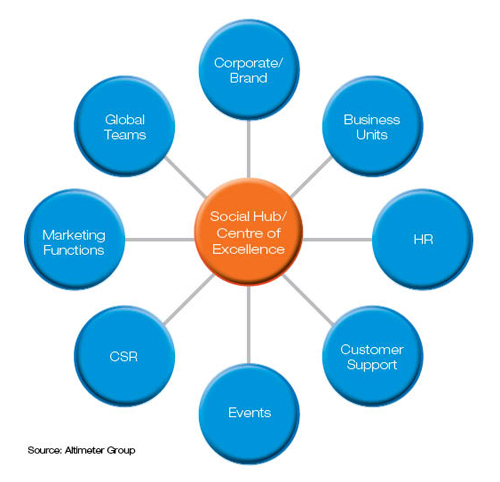
By aligning social media with business objectives, Adobe has created a ‘hub and spoke’ model and put social media at the very heart of the business, allowing social processes to spread organically across other areas of the business, including HR, customer support and marketing.

The social media 'Hub & Spoke' model

This ambitious approach has enabled Adobe to put a plan in place which has allowed the company to empower their employees across the globe to use social media to listen to their customer base and innovate.

An example of this would be the launch of Adobe’s Creative Suite 6. The company ‘ignited’ their 8 million strong social ecosystem to drive positive buzz, extend reach through live effects which consequently drove traffic and pre-orders. The result? three million YouTube views, six million web visits and a 10x ROI over a six week period.