Anyone can create a great customer experience

The Savoy

Last month I had the good fortune to stay at the world-famous Savoy hotel in the heart of London (for a special occasion – I haven’t hit the high life quite yet!). I had a brilliant time and one that made me think, too.

What struck me most about my experience at the Savoy – in addition to the art deco style, excellent food and brilliant location – was the superb level of service I experienced throughout my time there. From check-in to check-out I can’t remember one negative interaction with a Savoy employee.

Now, I know what you’re thinking: “If you’re paying £400-500 per night for a room, what do you expect?”

Service with sincerity

But of course, it’s not always as simple as that. I’ve stayed at a few other fancy hotels in my time and few of them have been able to deliver a level of service to the standard set by the Savoy. Likewise, I’ve also been to some very nice restaurants and bars whose service has been indifferent at best.

What made the service work so well at the Savoy was the sincerity in which it was carried out. At no point did I feel as though someone was saying ‘hello’, being helpful or simply smiling because they had to – it felt as though they actually meant it – and that really makes a difference.

Building a culture around great customer service

The Savoy (via Fairmont, the hotel’s operator) have consciously built great customer service into the culture, systems and processes of the business. They don’t see customer service as an add-on. Instead, it’s at the heart of the customer experience.

In much the same way as Disney have done at their resorts, the Savoy have made it their mission to ensure that every customer has a memorable experience when they visit the hotel. They’ve successfully leveraged their iconic building, history and focus on the customer to create something special.

Anyone can create a great customer experience

What I often struggle to understand is why more service businesses, especially hotels, restaurants, bars and cafes, for example, can’t take the same approach to customer service as the Savoy.

Regardless of the size of the business it doesn’t cost the Earth to hire the right people and train them to be polite, helpful and smile – at the very least! And it’s really not difficult to ensure that this is carried out consistently in order to provide a great customer experience.

With the rise of review sites such as TripAdvisor, Yelp and UrbanSpoon, consumers have never had so much information at their disposal. A few bad reviews could be the difference between someone making a booking – or not.

Surely, therefore, it makes more sense than ever to provide a great customer experience that leaves people with no other choice but to write very good things!


Link building versus link earning

As digital marketing continues to evolve and mature, so are the audiences who are exposed to the efforts of marketers constantly looking to get their attention. Brands who once relied on simple pop-up ads and advertorials to buy people’s attention are now flocking to social platforms such as Facebook, Twitter and Google+ to earn attention by creating unique content and engaging with followers through conversation.

And search engines, Google in particular, are also developing fast. Google’s Panda and Penguin algorithm updates were designed to target low quality sites relying on black-hat SEO techniques, such as content scraping, keyword stuffing and dodgy link-building. Whilst it was once possible to buy thousands of links and publish lazy copy, the emphasis has now been shifted and marketers have to put in the work to gain visibility in natural search.

It’s all about earning the right for people’s attention rather than simply buying it or gaining it through bad practice.

In last week’s Whiteboard Friday from SEOMoz, Rand Fishkin looked at the traditional SEO practice of link building from a new perspective – link earning.

We’re going back to the good old days!

In the mid-late 1990s links weren’t ‘built’ to fool the search engines into giving sites extra credit. They were generally acquired for the purpose of sending genuine, relevant traffic to one website from another.

But as search engine optimisation began to develop and high authority links (with a good Page Rank) increased in importance as a ranking factor, link-building started to become exploited, to the point where bought links, link exchanges and nonsense blog commenting became commonplace.

But as Google’s algorithm has evolved, particularly over the last 12-18 months, it’s now clear that digital marketers must now place a greater emphasis on earning good quality links rather than attempting to ‘game’ the system through the tired tactics of old.

Anything in life worth having is worth working for

Instead of buying links, earn links by creating great content that others will want to share. Instead of leaving blog comments for the sole purpose of receiving a followed link back, participate in a blogging community and add value in such a way that you’ll be noticed and gain links organically.

It all seems like a lot of hard work compared to the ‘old school’ techniques from the early-mid 200s. But that’s the point. To earn something of value you have to put the work in.

And link building – or link earning – is no different.


How to create a content strategy for Google+

Google+ by Fabrizio Van Marciano

This post was originally published on Smart Insights on 10th October 2012. I cross-post it here with all the links and tags for your reading pleasure!

The overall aim of brands using social networking is to create engaged communities around compelling content that educates, entertains, inspires and/ or angers.

The key, then, is to generate interest and ultimately Likes, Retweets, +1s, comments and shares for the content that’s being published. By generating interest for specific posts, users can produce a viral effect where that interest is then multiplied as a result of others throughout someone’s social graph being exposed to and then (hopefully) interacting with that content themselves. And so the cycle continues as their social graphs become exposed to the content.

Creating impactful content on Google+

One of the unique aspects of Google+ is the intuitive nature of the interface and the ability to easily filter and segment people and companies into custom Circles. By focusing in on specific Circles, users can control the information and content the see from others.

But in order to get Circled (whether you’re a company or an individual), you have to offer compelling content that benefits the user.

By looking at the most popular pages on Google+, as well as the ‘Explore’ option (which can be found on the left hand navigation), we can begin to discover what types of content is making the most impact for brands and draw a few conclusions as to what works best on Google+.

Be visual

One of the key features of Google+ is the visual nature of the platform. The interface allows users to post pictures and video that appear big, bold and in high resolution.

It may be a cliché but a picture really does tell a thousand words. It’s often worthwhile balancing the type of content you post to Google+. Whilst text may be necessary on some occasions, consider how users might respond to interesting, relevant pictures, too. These could be in the form of photography to tell a story, diagrams to explain a concept or an infographic to summarise rich or complex information.

Intel on Google+

Original video content is another great way to engage an audience and generate interaction.

A 500-word post can be condensed into a few minute’s video, allowing followers to digest information quickly and without having to read a long post.

Videos are also great for illustrating product demos, intro videos (e.g. to key personalities in your team or company), news announcements and animation.

Red Bull make full use of videos, many of which are dedicated to extreme sports and tied to their tagline “Red Bull gives wings to people and ideas” (which is consistent across the rest of their social activity).

Red Bull on Google+

Deals, offers and promotions

Followers of brands on social networks love to feel special and what better way than to let them know about special offers and promotions via a Google+ page?

Although Google has prohibited contests and promotions on Google+ pages, brands can display links on Google+ that point to external sites that are hosting the promotions.

Android use this to great effect, using their page to update fans on the latest Android news and guiding them to relevant offers and promotions.

Android on Google+

Ask questions

Reaching out to your followers and asking them for their opinion is an excellent way of keeping them involved with what you’re doing and what you’re interested in.

One of the main differentiating aspects of social media is the ability it allows companies and brands to engage in a two-way conversation with followers and customers.
Instead of just broadcasting to followers about what you’re working on and thinking about, build a connection with them and invite them to become a part of the process.

Ford have executed this tactic to perfection by regularly asking their followers whether they’ll be going to motor shows, where they might be driving on the weekend and of course, what they think of new ranges such as the new Fiesta.

Ford on Google+

Hangouts

Hangouts allow multiple Google+ users to participate in spontaneous video chats and is a feature brands can use to engage followers in targeted discussions or focus groups around the topics they care about.

Although only 10 people can participate in a Hangout at one time, the Hangouts On Air feature allows for Hangouts to broadcast to many more viewers who can watch events , product demonstrations or focus groups in real-time.

New York Times on Google+

Create content that your audience wants

Regardless of what content ‘works best’ on Google+, the content you post and share should always be relevant to your brand personality and most importantly, your audience.

Posting content will often involve a certain amount of trial and error so pay attention to what gets the most attention. Pictures and video may work well for one brand whereas wordy posts may be better for others.

Ferrari clearly know what their target audience wants – lots of cool pictures and videos of their stunning cars!

Ferrari on Google+

Whilst John Lewis’s marketing is very brand orientated (as demonstrated by their ads which are cross-posted on their Google+ page), it’s clear that the retail company’s followers also respond well to product-focused content, too.

John Lewis on Google+

John Lewis G+ on Google+(2)

And, of course, it’s not just big brands who have made an impression on Google+. Small and medium-sized enterprises are embracing the benefits of Google+, too, by making the most platform’ s key features and functionality.

Best Made Company is a US-based outdoor company specialising in the design and manufacture of handcrafted wilderness supplies. Their aim is to inspire others to get outside and use their hands and the company has used big, high-quality images of their products and inspirational videos on Google+ to help spread this message.

Best Made Company on Google+

And another US business, King Arthur Flour (America’s oldest flour company), have a very clear understanding of what their Google+ audience want – great pictures of great food (made with their flour!) and a personalised approach to their contact with followers.

King Arthur Flour on Google+

In summary, when creating your content for Google+ consider the following:

  • Creating impactful content and the use of Circles
  • Visual display
  • Deals, offers and promotions
  • Asking questions.
  • Hangouts
  • Relevant content for your audience

When is it right to @mention people on Twitter?

Twitter Bird Sketch by Shawn Campbell

As Twitter continues to mature and develop, so has its use and functionality among the 500 million people who use the platform.

When Twitter first hit the scene in 2007, it was used primarily to let others know where you were or what you were thinking in short, text message-sized updates (hence the 140-character limit). But as time has moved on, so has its users and the way they use Twitter to communicate

To @mention or not to @mention?

It was recently pointed out to me me that my use of @mentions when talking about someone (not directly to them) in a less than positive way was ‘intriguing’. I asked why and before they answered pointed me in the direction of this interesting point-of-view from comedian Robin Ince.

In his post, Robin considers the change in behaviour some people experience as soon as they get online. For example, normally shy people suddenly become confident and opinionated whilst others may go from being quiet and polite to noisy and angry at the sight of a provocative blog post, tweet or news article.

But more specifically (and part of the inspiration for this post), Robin also talks about Twitter and the use of the @mention. In his own words:

“The most unpleasant way of using Twitter is not the direct spit in the face, but the “I know you are here, and I am going to demean you without looking in your eye”. This is the “ had a great weekend, only ruined by seeing that unbearably shit @robinince”.

Robin’s post raises some very interesting questions about Twitter etiquette and what behaviour is either right or wrong when communicating (often anonymously) online with others.

Using @mentions as a ‘right to reply’

Whilst I agree with Robin on many of the points he makes, I do not necessarily share his view that @mentioning people in passing (e.g. “Just got back from seeing @johncleese live in London”) is always a bad thing. Whilst I have personally never (and will never) verbally abuse someone – directly or indirectly – on Twitter or any other social networking site, for that matter, I do sometimes say negative things about (high profile) people or companies in passing.

Although many people liken Twitter to real-life social gatherings (e.g. with many people standing around in a room talking with one another), I see it a little differently. Whilst I agree it has its similarities, it also has clear differences.

For example, Robin suggests that instead of @mentioning people in passing, Twitterers should @mention someone direct if they have something to say, e.g. “@johncleese Just got back from seeing you in London. It was great!”. But in my experience (and the majority of other people’s I’m guessing as well) someone like John Cleese probably wouldn’t respond to me if I did this. Whereas if we were in one big room and a spoke directly to him I’m pretty sure he would.

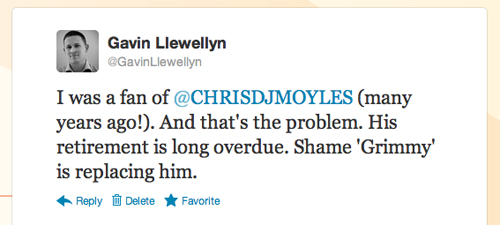
I therefore @mention people in passing in such a way as to give them a ‘right to reply’. For example, if I said something negative, such as the tweet about Chris Moyles (@CHRISDJMOYLES) below (N.B. I didn’t know Nick Grimshaw – or ‘Grimmy’, as I sarcastically refer to him as – had a Twitter handle at the time, otherwise I would have used @grimmers), by @mentioning him he will at least receive this mention by email or on a dashboard like Hootsuite or TweetDeck if he happens to use one. Whereas if I just mentioned him by name (e.g. “I was a fan of Chris Moyles…”) this would give him less opportunity to see what I have said about him in passing.

Chris Moyles @mention tweet


In keeping with the ‘room full of people’ comparison used above, I would see not @mentioning Chris Moyles as talking about him behind his back. Because he’s unlikely to respond to me if I @mention him directly, at least by @mentioning him in passing I’ve given Chris Moyles the chance to respond and come back at me if he disagrees or takes exception with what I’ve said. A discourse is then opened up.

I also believe in @mentioning people when I say good or not so good things about them. I try to keep things consistent so that others know what I think about people and companies, something that isn’t always possible if I @mention someone directly (unless they are following that person as well as me).

Manners still matter whether you’re online or not

But whether you see Twitter as being like real-life or not, good manners and respectfulness should still prevail. Although I can be critical about others on Twitter, I would never be outright rude or abusive. Just as I would hope not to be in real-life.

Whenever I talk to or about people on Twitter, I always think to myself “would I be prepared to say this to their face?”. If so, I go ahead. Otherwise, I’ll give it a second or two and reconsider.


Earning attention through really great marketing

Earned media by Tom Fishburne

Great marketing in the 21st century is about making the most of all your media options. Companies can no longer rely on just one media type to effectively get their message out to audiences. Instead, a blend of paid, owned and earned media is needed to stand out, gain attention and connect with interested prospects.

The changing media landscape

Whilst paid media (in the form of press and television advertising) dominated from the 1950s until the early 90s, owned media (primarily websites) began to make its mark as the internet burst into life from the mid-90s onward.

But as social media started to creep into the public consciousness just less than a decade ago (and continues to capture our imaginations now at a rate of knots), a combination of owned and earned media is gaining an ever-increasing presence and important role within the digital landscape.

Earned media = inbound marketing

Earned media, in the form of SEO, social media and content, offers businesses both big and small a huge opportunity to build brand awareness, engage audiences and drive sales for a fraction of the cost of paid equivalents. Also known as inbound marketing, earned media tactics can feed off one another in an integrated way to create content that resonates.

The key thing about earned media is exactly that – it’s earned. Instead of interrupting people with messages or promotions, you can earn their attention by providing something relevant, useful, compelling… or a combination of all three!

And with increasingly robust and powerful websites, and social communities, businesses and individuals are combining earned and owned media to create a set of digital assets that are offering consumers the opportunity to interact and engage with brands that was simply unimaginable only ten or fifteen years ago.

Bringing it all together

In another excellent post (and cartoon) from Tom Fishburne, the Marketoonist explains how the lines between paid, owned and earned media are blurring and that we have to earn all of our media more. Throwing money at a channel will only get us so far. We have to create something worth sharing and talking about.

It’s therefore essential that we consider how paid, owned and earned media can work together. For example, a great ad (paid) can generate conversation and word of mouth (earned) whilst many big social media campaigns (earned) often require a paid spark (the British Heart Foundation’s campaign from early this year demonstrates this point perfectly).

As the attention economy continues to get squeezed, it’s important that we find new ways to engage consumers. Complacent advertising, poorly designed websites and lazy social networking just won’t cut it.

We have to earn people’s attention by creating something special. Otherwise it will get lost in all the noise.


Using Google+ as an information network

I’ve been seeing and hearing a lot of criticism recently about Google+. Some have talked about it being a ‘ghost town’ or a non-entity, whilst others have been wondering what it even is!

Clearly Google+ hasn’t penetrated the mainstream to the degree in which they’d have hoped to have done at this stage in their development process but negative noises about the platform’s credibility and value are misjudged.

Social network vs. information network

Like many people, I use the many social platforms around in very different ways. For example, I use Facebook as a social network, where I can catch up on what friends are up to, Twitter as a micro RSS feed to consume information from various streams of updates and LinkedIn to connect with others on a professional level.

However, I see Google+ less as a ‘social’ network and more as an ‘information’ network. I use it rarely (if at all) to connect with friends and instead use it to tap into conversations, discussions and analyses on specific topics and subjects that I am interested in.

Follow specific interests

Google+ allows you to follow people who have a passion for a particular subject and follow updates that aren’t restricted to limited number of characters.

The ‘Circles’ function on Google+ allows users to group people they follow into any number of specifically tailored groups. Whilst I have Circles for ‘Social Media’, ‘SEO’ and ‘Marketing’, I’ve also grouped people and companies I follow into ‘Photography’, ‘Comedy’ and ‘Design’ Circles, too.

Although lists are also available on Twitter and Facebook, the intuitive functionality of Google+’s interface makes it fun and easy to dip in and out of the main news feed and into specific Circles to catch up on what it being posted by specific groups of followers.

For me, Google+ is also the only social space where I feel comfortable talking in depth about topics and subjects that I’m passionate about. Because Twitter is limited to 140 character posts, Google+ allows me to enthuse in detail about marketing, social media, films or sport.

Connect on a deeper level

Whilst I get a lot of value from following people with specific interests on Twitter, I’m unable to comment directly on the updates they post unless I Retweet them. And I don’t always follow the same people on Facebook or LinkedIn so it’s difficult to comment and discuss in those spaces.

Google+ is therefore a great place for connecting and engaging with opinion leaders and technical aficionados (i.e. ‘geeks’!) on a level I’m not always able to elsewhere. And because it is still a relatively new social platform, it’s sometimes easier to speak directly to people who are often out of reach on other channels such as Twitter or Facebook because of the sheer amount of followers and ‘noise’.

Understanding Google+’s unique qualities

I’m by no means a Google+ cheerleader and I’m still not 100% sure about where the platform will go and how it will develop over the coming months and years.

However, I do believe it’s important for users to consider Google+’s unique strengths and qualities before making sweeping generalisations and criticisms. Every social platform has it’s own idiosyncrasies and audiences which should be adapted to and respected if they are to be most effective.