Good SEO is about quality, not quantity

Quality Street ® by Alex Brown

I’ve read three articles recently that have inspired me to write this post:

The first was this excellent post from Christopher S Penn on the enduring rule of SEO. The second, a timely reminder from Google about selling links that pass PageRank. And finally, this deep-dive analysis of Interflora’s penalty for bad links by Christoph C. Cemper.

Add value through great content

All three articles have one big thing in common: SEO is about adding value by creating content that people want to share and link to.

Creating content that people will really value isn’t easy – that’s why SEO is considered earned media. Unlike paid search or advertising, good SEO cannot be achieved through quick fixes and short-term tactics. A good presence in the SERPs has to be earned over time through focused effort and considerate approach to SEO. But unfortunately sometimes the advantages of natural search traffic can motivate shady behaviour to try and ‘cheat’ the system.

Good SEO takes time, effort and hard work

Those looking to get genuinely good natural search results by trickery and dodgy tactics remind me of people who fall for the ‘6 pack in 6 minutes’ commercials. Just as getting into shape takes hard work, focus and a committed regime, so does SEO. Some ‘grey hat’ tactics can indeed work in the short term but they’re unlikely to be scaleable. And if they are scaled can land you in trouble (as Interflora found to their detriment in recent weeks!).

It’s important to understand that search engines, like Google, want to provide the most relevant search results for users. And in order to do so, they have devised algorithms that allows them to index sites based on a number of ranking factors. However, because search engines want to present relevant results, unethical tactics to ‘game’ the system are often frowned upon.

Don’t chase the algorithm

Whilst it’s important to recognise ranking factors and optimise websites accordingly, website owners shouldn’t try and ‘chase the algorithm’.

The Panda and Penguin algorithm updates over the past 18 months – 2 years have proved that Google are constantly tweaking and optimising the way they crawl and index websites. Just as keyword stuffing or building large quantities of spammy links used to work for SEO, they don’t any more and the sites that built their search strategies around these types of tactics suffered as a consequence.

The websites who are succeeding are the ones that have a clear strategy based on:

  • A relevant set of keywords and phrases related to the site
  • Best practice on-page SEO
  • Helpful, value-adding and shareable content
  • Quality links
  • Effective technical SEO

I’ve written before about SEO basics and best practices.

Good SEO is about quality, not quantity

This post is hardly original and it’s something that’s been stated ad nauseum by hundreds of SEO and digital marketing bloggers around the world. But ‘ethical’ SEO is something I believe in and I felt I needed to make my views clear here.

It may be tempting to look for shortcuts but the road to good SEO is about quality content that people value and not just the quantity of inbound links you can generate for a site.


Competitive intelligence analysis – 5 key reports

Othello! by Noah

Whilst it’s important to analyse how your own website is performing in terms of visitors numbers, customer demographics and conversion rate, competitive intelligence analysis can tell you how you are performing relative your competitors and provide some insight into their visitor numbers, audience, marketing and search strategies.

Effective competitor intelligence analysis can provide real actionable insights that just aren’t possible using standard web analytics tools such as Site Catalyst, Google Analytics or Webtrends. By understanding more clearly as to what your competitors are doing, you can make more insightful decisions about what to do with your online marketing activities.

Key benefits of conducting online competitive analysis

Competitive intelligence analysis allows you to gain insight on:

  • Competitor activity – Gain insight into the activities and tactics of your competitors.How are they using paid and organic search? What affiliates are they working with? What are the key times of the year when they implement certain tactics? Where are they gaining the majority of their traffic from?
  • Consumer behaviour – Learn how your target consumers behave on the web. Who – and what – are they being influenced by? And are their seasonal trends you should be aware of?
  • Paid and organic search opportunities – Identify when to use paid search to supplement your organic search efforts at peak times and where you rank in comparison to your competitors for the top search terms in the market. Also discover what key terms your competitors are bidding on and which are brining in the most traffic and custom to their website(s).
  • New business relationship opportunities – What partners and affiliates are your competitors working with? Who and what is referring the most visitors to your website?

This insight can provide you with ideas as to who you may be able to work with in order to maintain and drive more targeted traffic to your site.

Top tools for conducting competitive analysis

Effective competitive intelligence analysis isn’t cheap – but if done well it is well worth the cost. Whilst there are a number of low-cost/ free tools available, the market leaders such as Hitwise and ComScore provide excellent data and insight that no free/ low-cost alternative can rival.

Nevertheless, tools such as Google Trends, Compete and (to an extent) Alexa can provide some useful competitive intelligence insight at a much lower cost. And small businesses who may not be able to afford a full license from tools such as Hitwise can purchase custom reports for a particular set of insights.

Competitive analysis best practice actions

Using a number of the tools above, here are five key reports you can use to help identify competitor active, trends, consumer behaviour:

1. Industry benchmark – share of visits

A good way of getting a ‘top-level’ view of where you rank in your industry or versus a specific set of competitors is to benchmark yourself for overall visits.

An industry benchmark report provides a snapshot of your online performance in context with your competitive landscape.

The objective is to determine the big players and identify the ‘movers and shakers’ in your industry. Where do you rank against them? Where are there gaps that can be built on (if you’re ahead) or closed (if you’re lagging behind)?

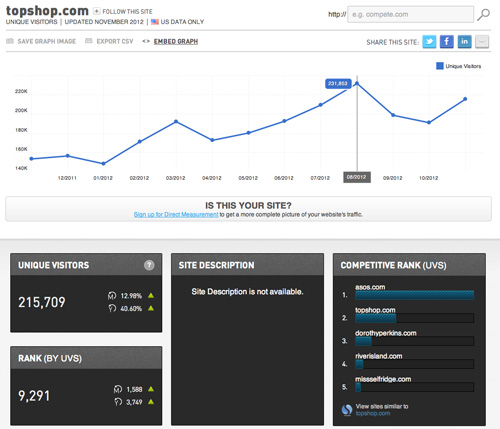
Using Compete, you can get an impression of how many unique visitors a particular website is getting and how they compare with similar sites as well as your own:

Compete unique visitor report

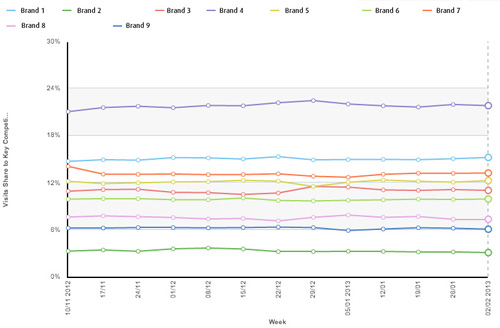
With Hitwise, you can build an even more accurate picture of where you are versus your competitors:

Hitwise share of visits report

2. ’Upstream and downstream’ visits

Upstream and downstream reporting allows you to form an impression of the behaviour, intention and ‘mindset’ of visitors to your website.

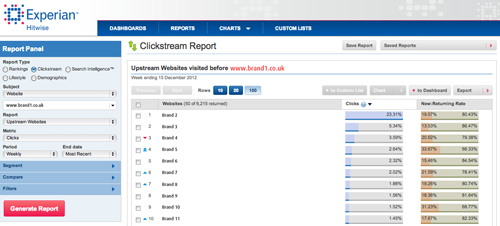
An ‘upstream’ report will show you what sites visitors have been to before visiting yours and shed light on the types of behaviour customers are displaying before they visit you.

However, the real benefit is in seeing where customers go before they visit your competitors.

For example, are they coming from search engines, aggregators or affiliate sites? Or are they coming from content heavy sites such as blogs or social networks? This type of insight gives you great insight into where you could be spending more time in order to connect with those potential customers.

Hitwise upstream traffic report

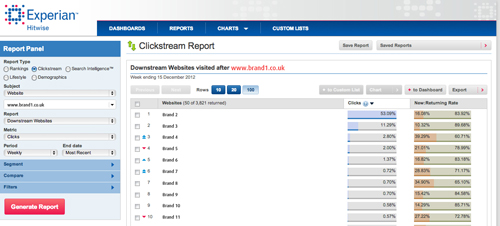
A ‘downstream’ report will show you the type of sites visitors go to after visiting yours.

Hitwise downstream traffic report

For example, how many people are visiting a competitor site or a search engine after visiting your site? Perhaps your price is out of kilter or your value proposition not compelling enough? Or maybe you didn’t provide the right information and so they returned to Google to search for something else?

3. Share of search

Search engines provide the vast majority of traffic to websites. And what’s more, organic search traffic is particularly valuable as it is focused, comprising of people intent on fulfilling their research and purchasing goals.

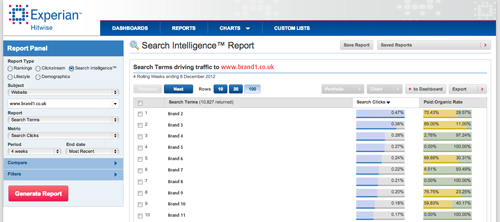
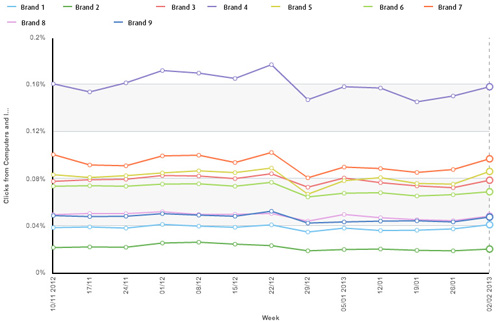
A share of search report can give you an indication of the percentage of traffic you are getting from search engines versus your competitors and provide insight as to how effectively your SEO strategy is performing against others.

Hitwise share of search report

The key benefit here is that a share of search report gives you an idea of fluctuations in search activity across the industry and can provide external validation of your search efforts. For example, if you notice an increase in organic search traffic for a particular month or period of time, competitor intelligence analysis can let you know whether your SEO efforts are paying off or if you (and your competitors) are just benefiting for an industry-wide rise.

4. Main traffic drivers

What type of sites are driving the most traffic to you, your competitors or the industry as a whole? A key traffic driver report will provide insight into the acquisition strategies of your competitors and possible opportunities that you yourself may not have exploited to their full potential.

Are your competitors relying a lot on search, social media or email? Are they using a set of affiliates that you have not considered? Or are they using a set of affiliates that you use but to a much larger degree?

Hitwise main traffic drivers report

5. New key term discovery

Competitive intelligence is great for discovering new key terms and phrases that you may have overlooked for your own site.

By looking at the terms driving traffic to your competitors’ sites and not yours, along with fast- moving search terms (key terms and phrases people are searching for most within a given time frame, for example the last few weeks or month) you can begin to formulate a ‘gap’ analysis.

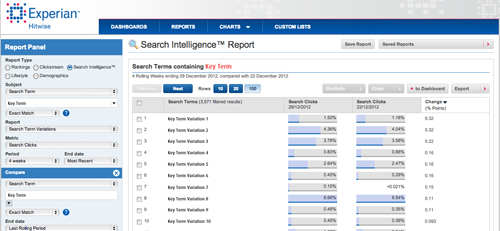
The picture below shows a key term variation report from Hitwise. A report like this can show fast-moving phrases around a particular keyword or term.

Hitwise fast-moving terms report

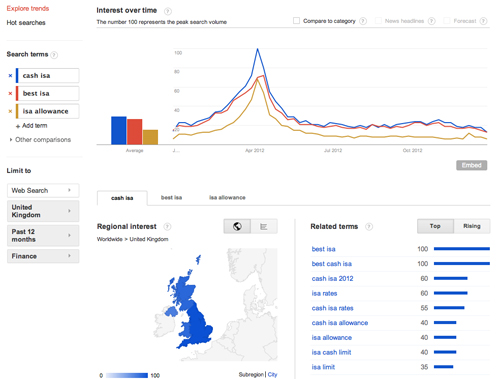
Google Trends is a really simple, cheap and easy way to look for new key terms and their popularity relative to others. And it’s also ideal for comparing brands and products over a period of time.

In the example below, we can see the strength of three ISA related key terms over a period of 12 months in the UK.

Google Trends report for ISAs

Although each terms follows a near identical trend over a year, peaking at ISA-time in April before dropping away in May and June, this data gives a good indication as to what people were searching for in relation to ISAs in 2012 and some insight into their buying behaviour.

A version of this post was originally published on Smart Insights on 4th February 2013. I cross-post it here with all the links and tags for your reading pleasure!


5 simple ways to protect your website

Warning sign by Robert Couse-Baker

Website security is a crucial aspect of website management, yet it’s an area that is so easily forgotten. Whilst we’re busy getting on with the fun stuff, be it writing blog posts, updating pages or improving the design and user experience, site security can often be overlooked.

Late last year, I learnt a harsh but very important lesson about website security when my website was hacked and infected with malware. I had not followed some of the basic security precautions and as a result my website was left vulnerable and open to attack.

In order to help others avoid some of the mistakes I made, I thought I’d jot down a few simple tips and actions that any website owners can take to help protect websites:

Back up regularly

Make sure you back your site up regularly. This can be done either manually (by transferring your website files from via FTP to your local machine) or if you’re using a CMS like WordPress there are free plugins such as the BackWPUp plugin which can archive everything into your Dropbox account on a weekly basis (hat tip to Chris Penn for this excellent piece of advice).

I also keep offline copies of all the blog content I produce on a separate memory drive so I know that this intellectual property (that forms the vast majority of all the content on my website) is kept safe.

Update your Passwords

Periodically change your FTP and any admin passwords as this is the main cause of sites getting infected. Make sure you choose a range of good passwords for your logins that include a minimum of 10 characters and contain letters, numbers and special characters, e.g. *, € or #.

The longer the password, the better. I’m terrible at remembering passwords so consider using lines from a favourite song or movie and replace some of the letters with numbers, e.g. ‘To be, or not to be, that is the question’ becomes ‘2beornot2bthatisthequest10n’.

Upgrade to the latest version of your website software

If, like me, you are running your site on a CMS like WordPress, make sure you update to the latest version as soon as it becomes available. It’s also important to ensure that all plugins are up-to-date, too.

The most up-to-date version of a CMS’s software should be more secure as it will include bug fixes and improvements to other security issues and vulnerabilities that may have existed in previous versions of the software.

Run an anti-virus scan

One of the most common causes for sites getting infected outside of security issues is via your computer. It’s therefore advisable to run an anti-virus scan on your machine or anyone that manages your site. There are a whole host of free antivirus software tools available, including:

Consider using a professional malware monitoring service

Sometimes there is only so much we can do ourselves. Hackers are getting more and more sophisticated and so it may be worth considering using a professional malware removal or monitoring service.

I use the aptly named Malware Removal Service who helped me with my most recent bout of malware and will now monitor my website over the course the year and make peridoic updates when necessary.

Some helpful resources

Regardless of how many precautions we take, website security is a matter of mitigating damages as nothing can ever be made 100% ‘hackproof’. We can only put things in place to help protect against and deter attacks. However, by following some of these simple steps we can help make our websites as secure as possible.


5 key social media marketing priorities for 2013

The Social Media Marketing Radar

Infographic: The Social Media Marketing Radar by First 10 and Smart Insights.

As another new year begins, marketers naturally look to develop their skills and awareness in the areas they are responsible for. For me, social media is a key area and within this, these are the areas that I believe are likely to effect social media marketing effectiveness in 2013. How do you see it?

1. Embrace social search

The launch of Google+ in 2011 and its continued development in 2012 is just one of many signs that traditional search is becoming increasingly influenced by social signals. Whilst great content and effective link building are still the most effective ways of optimising your website for search engines, genuine social media activity is also playing a part, too.

Google’s Search Plus Your World, its numerous algorithm updates and the introduction of the Knowledge Graph are yet more signs that quality content and social media will impact organic search.

Other factors such as social voting (e.g. the ‘Like’, ‘Tweet’ and ‘+1’ buttons) and social bookmarking (posting content to social sites) are also being used by search engines like Google to determine the influence and relevance of content on the web.

2. Adopt a content marketing strategy

Social media and search shouldn’t be considered as two completely separate disciplines. For some time now, there has been an overlap between search and social, with content being the glue the binds the two. They form the principles of what is known as inbound or earned media marketing.

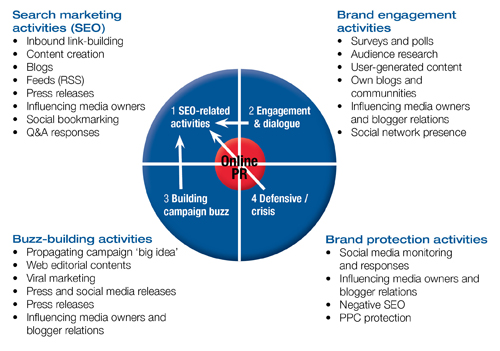
One of the most powerful and effective ways of combining search and social is to focus on developing an integrated content marketing strategy. Brands should consider a strategic approach to content to take advantage of the various content sources present within a business:

  • Search marketing activities
  • Brand engagement activities
  • Buzz-building activities
  • Brand protection activities

Creating useful, unique, engaging content is a powerful way of connecting with prospects and customers and it underpins many other marketing efforts, including:

A strategic approach to content

3. Differentiating your social presence

As social media has developed and proliferated our lives (so much so that even the blandest of products have a Facebook or Twitter account!), it’s never been so important to ensure that your brand has a presence that stands out and make an impression. People’s attention is at a premium in today’s ‘always-on’ world and in order to make a genuine connection with discerning consumers on the social web gaining visibility is essential.

First and foremost, good branding is key. Whilst it’s difficult to ensure perfect consistency on the social web (consumer conversations cannot be controlled to be “on brand”, especially when they turn negative), it’s still important to have strong, impactful and well-designed branding across every social platform to ensure it aligns with your website, products and online/ offline presence. Integration is key too.

As for social channels, don’t just focus on the one or two ‘that everyone is using’. Whilst it’s not advisable to create a presence on every social network going (e.g. don’t spread yourself too thin!), consider the variety of social networks out there and what will work best for you. It may be the case that Facebook and Twitter work just fine for your brand. However, you might just discover that niche social platforms such as Google+, Instagram or Pinterest could work better given your unique set of brand propositions and objectives.

4. Develop actionable insights through social analytics

Social media is no longer a buzzword that can be used to dazzle your boss and get funding for a new social media initiative. Companies, both large and small, are quite rightly demanding proof, evidence and case studies to demonstrate the value that social media can bring to a business.

Why should a brand invest in a social media campaign as opposed to a traditional advertising approach that is ‘guaranteed’ to reach X number of eyeballs through a targeted TV, radio or online advertising campaign?

Analytics and tracking should be used to evaluate the contribution of traffic from social media sources and sharing of content from your site on social networks. Hard data should be used wherever possible to monitor social initiatives so that you can form a much clearer picture of what techniques are most effective for your business and to build a compelling business case for further social media marketing should it prove successful.

Free tools such as Google Analytics allows users to track social media marketing using a series of reports looking at social sources, pages, conversions, social plugins and visitors flow.

5. Mobile is the present… and future!

Smartphone usage has rocketed over the last few years, with sales overtaking that of PCs two years ahead of schedule, tablet sales growing 378% year-on-year and news that in the US 90% of 18-29 year olds sleep with their smartphones!

It’s fair to say that with 4G making inroads in the US and now the UK, mobile and tablet usage is becoming increasingly ubiquitous. In the UK, mobile devices are now used for everything from buying goods and services to accessing the internet and social media on the go.

Facebook’s acquisition of Instagram for $1 billion in 2012 signified the social networking giant’s commitment to mobile moving forward and a clear sign that mobile will continue to play an increasingly important role in social media as the technology develops and users become savvier.

A version of this post was originally published on Smart Insights on 3rd January 2013. I cross-post it here with all the links and tags for your reading pleasure!


My 3 words for 2013

Thick encyclopedias with colorful hardcovers by Horia Varlan

Last year I continued my annual tradition of putting together my three main words to live by for the year ahead. This process has been inspired by the work of Chris Brogan who has been sharing his three words and encouraging others to do the same since 2006.

As another new year begins, I have decided on three new words that sum up what I want to work actionably on changing and improving in the coming year. But before I look at these, I think it’s worth reviewing my three words from 2012:

Focus

Attention is a scarce resource in today’s modern world of multiple social networks, apps, tablets and smartphones. I decided a year ago that instead of being distracted by all the bright, shiny objects around me I’d ensure that I gave myself the time and space to focus on bigger, more challenging projects and to create meaningful work.

In 2012 I managed to focus specifically on a number of projects, from building a brand new corporate blog to applying for a new job (in which I was fortunate enough to be successful!). All of these tasks required me to create work based on careful planning and focus.

Confidence

A key barrier to success for many is confidence. The confidence in one’s own abilities and the confidence to simply ‘give things a go’.

One of my goals in 2012 was therefore to have the confidence to form my own opinions and to express them confidently in front of my peers, both in person and online through blog posting and article writing.

Whilst blogging on my own site reduced slightly in 2012, I made up for this by increasing the amount of guest blogging I did, notably with Smart Insights – a site which is run and managed by a group of experts in their field.

Energy

I’ve always been inspired by individuals such as Richard Branson, Steve Jobs and Sir Alex Ferguson. Individuals who never seem to lose the passion, drive and energy they possessed when they were half their age!

I therefore approached 2012 with ‘energy’ in mind. The energy to focus on my goals and use my confidence to achieve them.


Whilst I will continue to build on my three words from 2012 (as well as my other three words from 2011), I’ve decided to look at three new words for 2013 to define my year: Expertise, Inquisitiveness, Imagination:

Inquisitiveness

Human beings learn and develop the most in their early, formative years. Children are constantly interested, intrigued and inquisitive about the world around them, allowing them to think, dream and learn openly and without cynicism.

I believe it’s just as important to remain inquisitive in one’s adult years, too. I don’t believe we ever stop learning and curiosity and keeping a genuine interest in everything around us is one of the keys to remaining open-minded, tolerant and receptive to change.

As a digital marketer, I’m faced with change on a near-constant basis. New social networks are springing up all the time whilst search engines tinker and change their algorithms every few months. It’s therefore important that I remain switched-on to what’s going around me as well as open to new ideas in order to make the most of such a fast-moving environment.

Imagination

Imagination is one of the keys to creativity. And I believe creativity is one of the best ways of producing work that inspires, engages and provokes.

I want to ensure that in 2013 I keep my imagination active and alert. I don’t want to become narrow-minded or too task-focused. Just as it’s important to remain curious and inquisitive, having an imagination will hopefully allow me to think more broadly and diverse about the work I’m involved in.

And how will I do this? Whilst I’ll continue to keep up-to-date with the latest marketing experts, bloggers and opinion leaders, I’m also going to keep reading and listening to great fiction and non-fiction, watch interesting films and TV shows and keep writing my own work and push myself to be more original, diverse and imaginative.

Expertise

I’ve always admired the craftsmanship of great experts such as carpenters, musicians, authors and architects. There’s a real sense of hard work, focus and proficiency in the work they produce.

In 2013 I want to continue refining my core marketing skills whilst building on new competences. Whilst I’d like to become more creative and imaginative, I also want to improve my analytical skills, too. I don’t believe I’ll ever become a complete expert – one never stops learning – but I’d like to become a marketer with a rich vein of knowledge composed of experience and continuing professional development.

So, here we go. Another 12 months to make things happen!

What are your 3 words for 2013?


How to use Google+ to engage influencers

Google+ Influencers

This post was originally published on Smart Insights on 6th December 2012. I cross-post it here with all the links and tags for your reading pleasure!

Influencer outreach is a popular tactic for mixing with opinion leaders and industry experts who have the ability to influence others to take positive action. Those actions may include sharing content, links or even signing up to newsletters or product demos.

The benefits of reaching out to influencers on Google+

Google+ is a very powerful ‘information network’, a place where many people (100 million, to be somewhat exact) go to connect with others around their interests and passions. Whilst Google+ may not have the sheer size in numbers of Facebook (with over one billion users), those active on Google+ are enthusiastic and highly engaged.

One of the benefits of seeking out influencers on Google+ is the impact Google+ content is having on natural search results. Unlike Facebook or Twitter, where search engines are largely restricted from accessing much of their data, content posted on Google+ is being indexed and appearing in the SERPs.

What’s more, users with large followings (who have been Circled by many people) and popular content (that is being +1’d and shared) are more likely to find their posts appearing in search results. Therefore, if an influential person with a large, engaged audience mentions you or links to your content in their posts, there is the potential that not only will it reach a large number of people but appear in organic search results, too.

But how can you find others who are true influencers in their fields of interest and/or expertise on Google+?

Take advantage of Google+ Ripples

One of the coolest features on Google+ is Ripples.

A Google+ Ripple is an interactive diagram that illustrates how a Google+ post spreads throughout users’ networks as it is shared and re-shared by others.
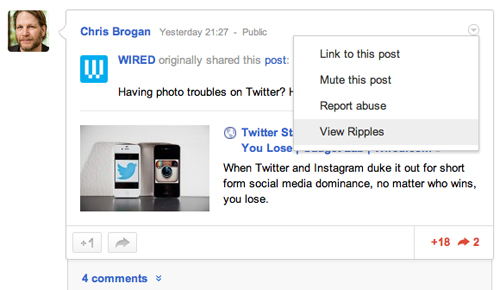
View Ripples

Ripples enable users to see:

  • Who is publicly sharing posts or URLs and the comments they’ve made
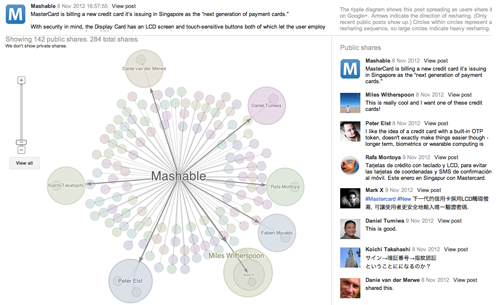
Mashable Ripple example

  • How a post or URL was shared over time
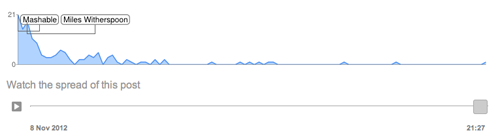
Mashable Ripple timeline example

Ripples provide an animated version of the visualisation so users can see how a post or link has been shared over a period of time.

  • Statistics on how a post or URL has been shared, including a breakdown of languages:

Mashable Ripple stats example

Getting a top influencer to share your content is pretty difficult to achieve. However, the great thing about Ripples is that it allows you to determine not just who the main influencers are but also the influencers of the influencers!

Use Ripples to find an influencer

Lets imagine you or I were to write a post with the hope of Chris Brogan, a top influencer on Google+ (and across many other social platforms, too) sharing it with his network. Getting Chris to share our content directly might be a little tricky, as we may not have a direct relationship with him. So we would therefore have to find someone who he is connected to and might be easier to approach.

The first step would be to look through Chris’s Google+ posts and consider the type of content he is sharing with his Circles. What are the topics that most interest him? What makes him tick?

We would look for a post that Chris has shared and has subsequently been re-shared and then view the Ripple:

Chris Brogan Ripple example

The key is to look for Ripples where the original poster has an account that is in a good number of Circles and has a small but strong following (although Mike’s 26,953 Circles is by no means ‘small’, it is nevertheless significantly smaller than Chris’s 103,763).

Make a connection

Because Chris shared Mike’s post there’s clearly an element of trust between them. And if they trust each other on Google+, they may also be connected and influenced by one another on other social networks, too.

If we look at Mike’s ‘About ‘ page we can see that he is also active on Facebook, Twitter, LinkedIn and YouTube, too, so there are a number of other ways to reach out and connect:
Mike Stenger's social networks

Therefore, making a connection first on Google+ may then lead to a connection – and a genuine relationship – on other platforms.

Establish a relationship and share content

Once a connection has been made, the key is to then develop a genuine relationship and share content openly with Mike in the hope that he will re-share it with his network. Although there is no guarantee that Chris Brogan will see our content if it gets shared, it will nevertheless get exposed to Mike’s network, both on Google+ and perhaps on other social platforms such as Twitter, Facebook and LinkedIn, too.

For more advice on how to use Google+ Ripples for influencer outreach, check out this excellent post by Casey Henry on SEOMoz.

Google+ notifications

Google provides 17 different notification prompts that allows users to connect with influencers in their sector, niche or industry.

Although much is dependent on an individual’s Google Account settings, each of these 17 notifications can take the form of phone, email, SMS or the red Google notification bar that is present on most of Google’s services.

Google notifications

To trigger a notification:

  • Share a post someone directly
  • Mention someone in a post
  • Start a conversation with someone
  • Comment on a post someone has created
  • Comment on a post after someone else has commented on it
  • Share a post and you’re in a Circle they subscribe to
  • Add somebody to a Circle
  • Suggest new people to add to other people’s Circles
  • Send someone an invitation or update an event
  • Remind someone about events
  • Any activity on events someone has created
  • Tag someone in a photo
  • Tag somebody else’s photos
  • Suggest a profile photo for someone
  • Comment on a photo after someone else commented on it
  • Comment on a photo someone is tagged in
  • Comment on a photo someone has tagged

Google’s notification system means that there is a multitude of ways to get yourself noticed and connect with influencers via Google+. However, be warned: Do not go overboard and bombard people with notifications as this can quite easily (and forgivably) be perceived as ‘spamming’ and you may be unfollowed/ un-Circled/ blacklisted as a result!

Use Social Statistics

If you’re looking for people and brands with particularly large audiences, take advantage of Social Statistics.

This nifty site allows you to quickly and easily discover the top people on Google+ based on their follower count.

Social Statistics

Once you’ve identified the type of influencers you want to reach out to, consider following the steps outlined in the Ripples section above and look at ways of connecting with the influencers’ influencers in the hope of getting your content exposed to their networks of followers.

Seek out industry experts in Google+ Search

The search functionality on Google+ itself is a great way of discovering experts, opinion leaders and influencers in your industry.

Simply type in a keyword into the search box at the top of Google+ and filter the results for People and Pages.
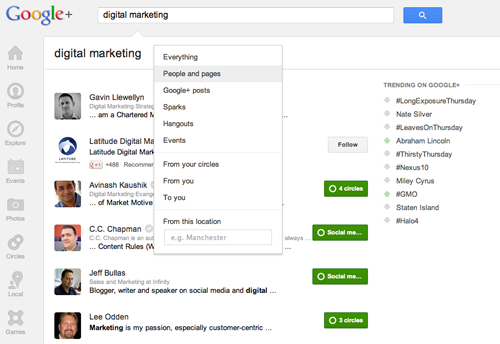
Seek out industry experts with Google+ search

As soon as you’ve identified a list of influencers you’d like to connect with, Circle them and begin sharing unique, valuable, interesting content.

Other cool tools and applications

In addition to the methods listed above, there are also a few other cool tools and browser extensions that you can use to discover influencers on Google+.

GPlus+ Search

GPlus+ Search is a Chrome app (available from the Chrome Web Store ) that allows users to search public Google+ content and profiles quickly and easily from within their Chrome browsers.

GPlus+ search on Chrome

Although the results presented aren’t a great deal different to those presented when searching within Google+ itself, it’s a very handy tool for making a quick search for posts or profiles around specific key terms when you’re not in directly in Google+ at the time.

Using GPlus+ search

FindPeopleOnPlus

FindPeopleOnPlus is a Google+ directory site that allows users to search for influencers by key terms and category.

FindPeopleOnPlus

Where FindPeopleOnPlus is particularly useful is in the functionality it provides users to filter their search for influencers based on a variety of categories, including profile type (person or brand), country, city and occupation.