The relentless pursuit of victory

Sir Alex Ferguson MUFC

In May last year, I wrote a post about the virtue of perseverance and never giving up. It was written the day after a dramatic final day of the English Premier League season when Manchester City clinched the title in the dying minutes of the campaign. As a Manchester United fan, it was hard to take – they themselves were only seconds from glory! But I nevertheless appreciated the resolve Man City showed to win their first league title for 44 years.

However, in that blog post I also recognised the following:

“I expect Manchester United to use this year’s league defeat to learn the lessons needed to improve for next season… I’m hoping that this time next year I’ll be writing about how Manchester United are champions again and the lessons we can learn from their inspiring return to glory!”

Manchester United duly responded and won the 2012/13 campaign at a canter with four games to spare, in the process winning their 20th top flight title (and 13th Premier League title). In this post I was going to expand on the many attributes Manchester United have shown this season – determination, drive, perseverance and an appetite for success.

It’s no coincidence that the virtues Manchester United have shown this year are also those of their manager, Sir Alex Ferguson, who this week announced his retirement from the game after 39 years in football management (26 at United). In tribute to Manchester United’s success and to Sir Alex Ferguson’s reign as manager, I thought I’d reflect on some of the qualities, characteristics and ethics that make them both so great:

Work ethic

Great teams like Manchester United have the unique ability to bounce back from defeat despite the agony of disappointment that must certainly consume the squad, management and individual players’ minds whenever they lose.

This season has not been a vintage year by any means, however it’s not necessarily their physical skill and ability that I admire so much – it’s their attitude and collective will to succeed that is so mind-blowing.

The work ethic and drive for success has propelled them to the title this year and it’s the term ‘work ethic’ that I have heard so much in the tributes that have been paid to Sir Alex Ferguson this week. Skill and flair is all very well but without the foundation of hard work these count for nothing.

A culture of success

It can’t be an accident that Manchester United’s dominance over the last 20 years has coincided with Sir Alex Ferguson’s presence as manager. During his time in charge, Ferguson has presided over numerous iterations of the squad – some good, some very good and some rather average.

Yet despite the various ups and downs, Manchester United have consistently over-achieved and this is very much down to the culture of success that has been instilled at the club and cascades down from the first team to the academy.

A unifying culture can give any organisation a competitive advantage over their rivals. Whilst Manchester City and Chelsea have spent millions building their clubs over the last 10 years, Manchester United have continued to succeed with squads they may be arguably inferior to their adversaries. And yet they have continued to challenge and win when others might be expected to fail and the strong culture has played a leading role in their success.

A relentless pursuit of victory

At 71, Sir Alex Ferguson’s retirement could be considered to be long overdue and yet he has persisted whilst others have not. Football management, especially at the highest level, is surely no walk in the park so what is it that has kept him going?

Without a doubt it’s the burning desire to win that has driven him to the countless trophies and championships he has won with his teams over the last 39 years and it’s this appetite and relentless pursuit of victory that was so evident in this season’s Manchester United team.

Having this clear goal and vision has allowed the entire squad to remain focused on exactly what they wanted to do: to reclaim the Premier League title they so narrowly lost to their local rivals last season.

The story continues…

As with any other organisation, all good things must come to an end. Nobody can lead forever and although Sir Alex Ferguson will forever be regarded as one of (if not the) best football managers of all time, at some point the baton had be passed on to someone else.

Whilst the retirement of Sir Alex Ferguson may seem like a devastating blow to the fans and supporters, the management have no doubt been planning for the day he would finally away for years. Effective succession planning allows for the performance of an organisation to continue with a seamless transition and this is surely the goal Manchester United have in mind with the appointment of David Moyes.

Whilst Moyes is not Ferguson, it is hoped that the squad, structure and finances in place at United will allow him to continue building on the winning culture the club has fostered so that victory will always be an expectation and never just a hope.


How to evaluate consumer search behaviour

Consumer search on Google

In March I covered how one can start to evaluate and forecast the potential benefits of SEO by considering the possible traffic volume that individual keywords and phrases can drive to your website based on CTR in the SERPs.

Whilst it’s important to build the case for using SEO and to develop keyword lists as a result, it’s also important to understand different customer behaviours and to group them as part of your keyword strategy. This helps to set targets, audit performance and provide ideas for content development. Content may be king but it’s essential that the right content is created for the right audiences.

By establishing the type of search behaviour exhibited by consumers, you can start to consider not just the different types of content you might need to produce but also where this content will fit within your site, the necessary landing pages based on what stage in the purchase funnel the consumer is in and the priority based on conversion rate.

Helpful tools

There are a number of free tools on the web that you can use in order to start creating keyword lists based on consumer behaviour and intent. The goal is to create a set of behaviour-based lists that you can then use to start feed into Google’s keyword tool to refine further.

Mergewords

This simple tool helps you to brainstorm new phrases by merging keywords using up to three terms to create new combinations automatically.

MergeWords

Whilst it may not be the most sophisticated tool available, if you have a variety of different keyword combinations and need help putting them together to form possible phrases, Mergewords is a handy tool to get you started.

Soovle

This is a search suggestion box that informs you of related search patterns from eleven key search sources, inlcuding Google, YouTube and Bing.

Soovle

The cool thing about Soolve is how it links suggestions to different search sources, thus providing insight into the phrases that are likely to work best on particular channels. Whilst location based phrases (such as ‘cupcakes Manchester’) might work better for search engines, informational phrases (such as ‘how to decorate a cupcake’) might be more appropriate for something like YouTube, where searchers are looking for more practical, visual sources of information.

Übersuggest

Übersuggest is an extended version of Google Suggest (the related terms that appear when you type into the Google search box) and what’s really helpful is that when you search for a keyword it will add a suffix for all letters in the alphabet and give you related terms associated with each.

Ubersuggest

Übersuggest allows you to quickly and easily build a set of keyphrases, both short and long-tail based on a range of different user behaviours.

Techniques for understanding search journeys

As well as using a number of helpful tools to brainstorm keyphrase ideas, there are also useful techniques you can use in order to identify users’ possible ‘search journeys’.

Whilst short-tail phrases attract more volume of searches, they are far less goal-oriented and therefore convert much lower than longer, more transactional terms that consequently have less volume. The key is to identify the right mix of relevant short and long-tail key phrases for your business and attribute the correct consumer behaviour to each.

Continuing with the example I’ve used in this post, ‘cupcakes’ can be considered to be the ‘root’ term. This can then be refined and expanded on by adding extra words to build more purposeful, long-tail key phrases.

Pattern recognition through qualifiers can be used to build on and augment core search terms using eight common qualifiers (as identified by Econsultancy):

1. Adjective (price/product qualifiers) – “cheap/bespoke cupcakes” – quality may be an issue for these type of phrases so a decision needs to be made as to whether this is appropriate for the brand

2. Location – “cupcakes nottingham” – this is particularly useful for smaller, local businesses who can gain traction by using location within meta data (titles and descriptions) and/ or PPC ad copy

3. Brand – “Katie’s Cupcakes” – important for establishing brand presence and visibility for those already familiar with your brand

4. Product – specification or feature – “chocolate cupcakes”.

5. Product type – ”vegan cupcakes‟ – often low volume.

6. Intended use (application) – “birthday/ wedding/ anniversary cupcakes”.

7. Comparison/quality – “compare cupcakes”

8. Action request – “buy cupcakes” – high intent and very competitive.

Once you’ve defined your lists of key phrases, the next step should involve grouping these into logical tables based on the type of behaviour they will be aiming to attract:

Key phrase list

Once you’ve got a set of relevant keyphrase lists tied to different consumer behaviours, use Google’s keyword tool to calculate the potential search volume for each. You should then have a finalised set of phrases that you can begin to optimise for across your site!

A version of this post was originally published on Smart Insights on 7th May 2013. I cross-post it here with all the links and tags for your reading pleasure!


Engage brain before… using social media!

Zippy Shut Up by Steve Winton

The demise this week of Paris Brown, Britain’s first youth police and crime commissioner, highlights many of the potential pitfalls of speaking your mind using social media. Following a report in the Mail on Sunday, it emerged that the 17-year old tweeted a number of racist, homophobic and potentially offensive comments between the ages of 14 and 16 that has ultimately led to her very public resignation.

Aside from the obvious social and moral issues, it’s also worth considering the role that new media played in this particular case and the lessons they can teach all of us – both old and young.

Conversations in social media are not ‘private’

The growth and proliferation of social media has given everyone the ability to broadcast and publish any thought, idea, musing or insult to millions of people across the world. If Ms Brown had made similar comments online only 10 or 15 years ago (most likely via instant messenger), it’s unlikely they would have surfaced in quite the way they did last weekend.

But with the advent of powerful social networks, notably Facebook and Twitter, conversations and comments can no longer be considered private regardless of privacy settings or protected tweets.

Consider your ‘digital footprint’

The Paris Brown case is particularly pertinent for young people. When I was growing up, there wasn’t the ability to talk so openly and candidly online with friends and followers in the way we can today. And whilst I would never have said the type of things Ms Brown tweeted, given the opportunity I might nevertheless have talked about things I might later regret should a potential college, university or employer stumble across them during a routine background check.

My advice to anyone venturing into social media is to consider anything you say online to be both public and permanent. It’s worth imagining what you, your family, friends and colleagues would think should any comment you make online appear on the front page of a national paper the next day. In the heat of the moment, a throwaway remark might seem like a good idea but how would you feel about it hours, days or even years later?

Everything you publish online is a reflection of you, even if it’s just a snapshot from a moment in time. Whilst comments can often be taken out of context, unfortunately first impressions and perceptions are made nonetheless so it’s up to you to take control of your image and reputation online.

Leverage the positive power of social media

Whilst Paris Brown’s experience with social media has been a negative one, I think it’s also worth considering the many positive opportunities social media can offer.

As well as Facebook and Twitter, other social networks, notably LinkedIn, Pinterest and Google+, give users the ability to publish, create and share thoughts and experiences that wasn’t possible only a few years ago. Whilst we must always be vigilant online, we should also embrace and leverage the opportunity to build a positive personal brand and reputation using a portfolio of exciting, creative and engaging social channels.


How to forecast the potential benefit of SEO

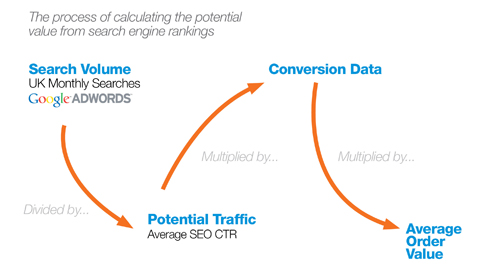
The process of calculating the potential value from search engine rankings

Search engine optimisation is one of many digital marketing tactics a business can choose from. Email, pay per click, display and affiliate marketing are all in many companies’ marketing armouries, and whilst the cost per visitor for natural search is zero, in order to achieve organic success within the SERPs investment is required.

Cheap, ‘black hat’ SEO tactics such as buying links, keyword stuffing and cloaking used to work for those looking to get visibility within the search results, but now a more considered approach to on-page optimisation, content marketing and link earning is now required to rank highly for popular search terms. Therefore, in order to get investment and buy-in for SEO it’s not surprising that business leaders require a compelling case as to why SEO should be pursued.

How big is the SEO prize?

Before you can start building the case for SEO, you must first set the scene by illustrating the ‘size of the prize’.

Carry out an audit of your website and use your web analytics to identify what natural search is currently contributing to the business. By understanding how much value SEO currently contributes in terms of visits, conversions, leads and sales, you can begin to understand where you currently are and where potential improvements can be made.

Build the case for SEO

Once you have carried out an audit and created a baseline to measure against, you can start putting together a case, with numbers, to illustrate how improvements to natural search by using SEO can positively impact the business.

There are four key steps to follow:

1. Focus on Google – for now

According to an Experian Hitwise study in October last year, Google provides 89.33% of all web searches in the UK. Whilst it’s important not to become too myopic and build your site around just one search engine, it makes sense to recognise Google’s current dominance in the search space.

Therefore, for the purpose of this post, I’ve decided to consider just Google in my calculations and I’d suggest you do the same for the time being.

2. Estimate potential search volume for top terms

Assuming you have already conducted a keyword gap analysis to identify the terms most relevant to your site, the next step is to estimate the potential search volume for the top search terms you want to optimise for using Google’s Keyword Tool.

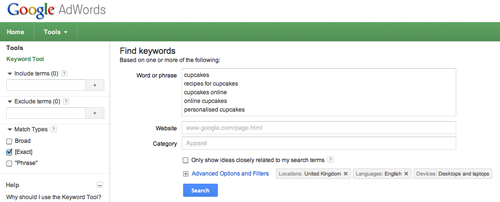
Take each of the main key phrases and drop it into the tool:

Google keyword tool

Select the UK for ‘location’, click [exact match] for ‘match type’ and hit ‘search’:

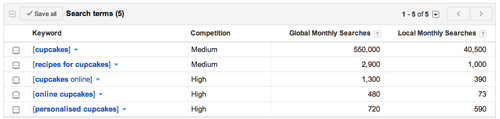
Main key phrases

The output from this activity will give you an indication as to the number of searches specifically for those key phrases per month. Remember that ‘Local Monthly Searches’ refers to the UK and it is this figure you should consider.

3. Estimate Google Click-through rate percentage

You will be competing for only a share of the number of searches from the Google Keyword Tool activity we looked at above. So the next task is to determine what percentage of those monthly searches you can potentially get to your website.

One way to do this is to consider the click-through rate from organic listings on page 1 of Google.

An Optify study in 2012 showed a position 1 ranking achieved 36.4% CTR, over 24% more than position 2.

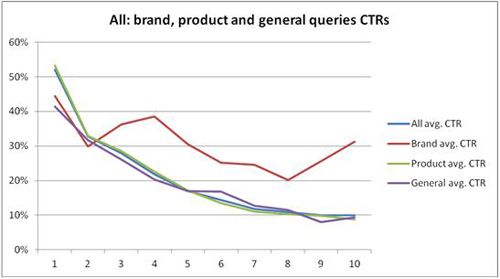
Whilst SEOMoz released research showing average CTR % for brand, product and general searches, indicating that websites ranking in position 1 had a 52% CTR.

SEOMoz CTR research

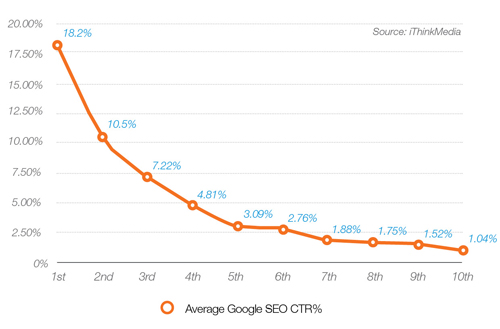
However, iThinkMedia, a UK-based search marketing agency, provide figures based on research they conducted with a range of clients, which indicates similar results to the studies above with the exception of position 1 rankings.

The 18.2% click-through rate for position 1 is certainly more conservative than SEOMoz’s 52% and Optify’s 36.4% but that’s not necessarily a bad thing as in my experience it’s often better to under promise and over deliver when making predictions such as these!

Average Google SEO CTR %

The chart above does not break out brand and non-brand terms, and is also not sector specific. And of course there are many other caveats to be aware of (for example, this approach fails to consider the impact of universal search, search intent or the effect of rich snippets on CTR).

Nevertheless, the chart still provides an approximate idea of potential CTR based on where you rank on page 1 of Google and is a good starting point for anyone considering the impact of rankings on traffic to their website.

(For a closer look at sector-specific CTRs for rankings, check out this excellent post featuring some really interesting and useful infographics).

4. Calculate potential traffic and sales

The final step is to put all the data together in a format where you can clearly show what traffic can be obtained from appearing 1-10 on Google and how this translates to traffic and sales.

The last piece in the puzzle is to calculate how each main key phrase converts. This is something that can be done when carrying out an initial audit of your website’s current SEO performance.

Working out the conversion rate of specific sets of key phrases will allow you to determine the potential traffic and revenue return by ranking in positions 1-10 for the highest volume search terms.

Final calculations when estimating SEO traffic

Once you know the conversion rate this can then be multipled by your average order value to give you a rough indication of how sales could be affected by improved natural search traffic for your top key generic search phrases.

A version of this post was originally published on Smart Insights on 20th March 2013. I cross-post it here with all the links and tags for your reading pleasure!


Why I work

Work in progress by Kevan Davis

Like many people, I spend the majority of my time at work, more often than not in an office building away from home and with people I have not actively chosen to be around. Yet when one activity dominates such a large proportion of one’s life, in my opinion it makes sense to try and enjoy and take something away from it, otherwise life can begin to feel like somewhat of a waste.

Put a ding in the universe

The reality is that we go to work because we have to. We’ve all got bills to pay, food to buy and goodies to enjoy. And whilst this reality is clear to me, I’m trying to figure out what I can do in order to make the most of my time at work so it doesn’t become just a chore.

One of the ways I’ve found to get the most out of work is to have a philosophy or raison d’etre. Whilst this might sound a little fancy or pretentious, it’s really just about having a clear outlook and set of beliefs and values about what you want to do in your working life. It’s a way of keeping sight of why you do what you do. Otherwise you become just a number, another cog in the machine.

I can’t stand the idea of looking back on my life and wondering what I really accomplished over all those years. I want to be able to look back and know that I made a genuine contribution to the world. Or, as Steve Jobs said, put a ding in the universe!

Why I work

I’ve realised over the last few years that the reason I work is because I want to add value to people’s lives. When I think about the people I admire most (which includes The Beatles, Richard Branson, Stephen King, Walt Disney, Steve Jobs) it’s clear that they all share something in common: they have all enriched people’s lives.

Whether it’s through music, technology, art or storytelling, the people I look up to (both personally and professionally) have all created something that enhances people’s existence in one way or another. And they’ve done this not through simple, short term actions but by creating something meaningful that really matters, for themselves and for others.

Whilst I may not have all of the natural and learned ability as many of my lofty heroes, I like to think that because I have a clear idea of why I do what I do, this will continue to inform what and how I do things so that I can continue to look for ways of adding value in different fields of work, hobbies and pursuits.

I think it’s important for anyone looking to create something meaningful to know why they work. An underlying philosophy provides focus and direction for why you turn up to the office 8+ hours a day, 5 days a week for the best part of 47 weeks of the year. For me, it’s about adding value in whatever I do so I can look back at the work and contributions I’ve made throughout my life and be proud of what I’ve achieved.

That’s why I work.


6 tips for a successful digital agency partnership

'mans' by Xavi Talleda

Over the last 7 years, I’ve had experience of working with various different traditional and digital marketing agencies. Whilst one agency’s skill set may differ from another, what I have found to be consistent is the way in which many agencies operate and how clients can get the best from a working relationship with them.

Working with a marketing agency should be a collaborative relationship. With digital marketing moving at such a frightening pace, it’s important to work closely with an agency and allow them to provide strategic insight and know-how whilst acting as an extension of the client’s in-house team.

In this post I’d like to share a few thoughts on how you, as a client, can establish a productive working relationship with your digital marketing agency so you can make the most of the partnership.

1. Set out your goals and objectives

In order for an agency to understand what you want to achieve, it’s important to clearly outline your goals and objectives early on in the relationship (as early as the pitch process and then re-iterate as priorities change).

These goals need to be aligned with what your particular agency or set of agencies can deliver. A digital marketing agency can come in many different forms:

  • Integrated – often a digital extension of an already established traditional marketing agency
  • Digital full-service – offer a combination of SEO, social media and affiliate marketing services with web design capabilities
  • Search marketing specialists – search engine optimisation specialists, often with expertise in pay per click (PPC), too
  • Inbound marketing specialists – these include agencies that specialise in content marketing, with expertise in social media, SEO and content production
  • Mobile marketing specialists – focus on apps, mobile messaging and potentially site design.

The key is to establish early on exactly what you want to achieve and how an agency can help. By being honest up front, it will allow you to choose an agency that has the right skills, expertise and personnel to help you work to fulfilling your business and marketing objectives.

2. Establish agreed working arrangements

Once you’ve decided on the digital marketing agency you want to work with, the next step is to establish an agreed working arrangement.

It’s important to agree from the beginning:

  • What will be the nature of the work? Strategic, tactical or a combination?
  • What is the service level agreement (SLA) and the turnaround time for work?
  • How will you measure activity and results? What KPIs will you measure?
  • Who will meet whom, when and how often?
  • How will the briefing process work?
  • How will information and data be shared and distributed?

By establishing an agreed working arrangement, both you and your agency can go about your work with confidence, knowing who is supposed to play what part.

3. Create focused briefs

Many clients often expect their agency to read their minds and figure out not only the problems they have but also how to solve them. However, without a tight, focused brief that outlines exactly what you want and how you want to achieve it, you’re unlikely to get the best our of your agency.

Whilst it’s the agency’ role to provide insight and expertise that the client lacks internally, it is the client’s role to guide an agency towards the work they want produced. It’s therefore up to you to provide the agency with detailed briefs that contains:

  • Business background – what are you trying to achieve
  • Objectives
  • Target audience
  • Key messages
  • Timings

Much of what you’re looking to achieve and your objectives will allow your agency to consider the best digital marketing approach to take. What may have initially seemed like a straightforward link-building project for SEO, may in fact turn into a content marketing project that encompasses both SEO and social media marketing.

However, a collaborative approach always works best and allows the client and agency to align their thinking.

4. Keep on top of budget and costs

Considering the current economic climate, budgeting is more important than ever. Whilst you may be working on a retainer with your agency, there may also be projects that are an extension to this agreement.

Regardless of the size of a project, always consider the agreed budget and ways to keep on top of growing costs. Whilst I am not suggesting that your agency will be looking to rack up costs for their own benefit, it is in their interest to produce as much work as possible.

Agree early on the scope of the project and ensure you manage both your agency and internal stakeholders effectively to keep control of budget, costs and timings.

5. Focus on knowledge transfer

When working with a digital marketing agency, always consider how you can benefit from knowledge transfer at every touchpoint of your relationship.

An agency with have a depth of knowledge and expertise that is unlikely to exist within your company (that’s why you’re working with them!). Working with them will therefore give you the opportunity to learn and develop as a result of the work you produce together.

Never become overly reliant on what your agency is telling you. It’s important to build up an understanding of your own so that you can more confidently challenge them on their proposals, ideas and suggestions.

6. Measure results

As with any activity, measurement is key. Go back to your initial meetings and discussions and consider what you’ve achieved over time since working with your agency.

Go over the shared goals, objectives and KPIs you set up with your agency and ask whether you’ve achieved what you’ve wanted with them over the time you’ve been working together.

If your agency specialises in SEO, then you’ll want to have seen an improvement in overall rankings for your top target key phrases, an increase in non-brand organic traffic and an improvement in the quality of visitors to your site.

Whilst if you’re working with an agency that specialises in social media marketing, you’ll want to have seen an overall improvement in engagement with your content, brand awareness and consideration of your product/ service portfolio through multiple social channels.

The key is to analyse not just how the agency has performed, but how both you and your agency have worked together to meet the objectives set out from the start of the relationship. By making an honest assessment, you can then work out how to move forward.

A version of this post was originally published on Smart Insights on 27th February 2013. I cross-post it here with all the links and tags for your reading pleasure!