How to measure social media ROI

Social media return on investment (ROI) is becoming an increasingly important topic for many businesses as leaders and managers continue to ask for justification and sound reasoning for spend on social media activity.

In this short but sweet video from Salesforce.com, Dr. Natalie Petouhoff, with the aid of some excellent graphics, explains what ROI is and how one can measure it for a company’s social media efforts. Dr. Petouhoff uses a customer service programme as a case study and illustrates (quite literally!) how the ROI calculation can be made.

I’ve seen, read and listened to a LOT about social media ROI over the past eighteen months as well as numerous arguments and debates about it. And yet in a simple six minute video, Natalie Petouhoff manages to get across the key points of a straightforward yet very important business metric.

If you’re having trouble viewing this video, you can view ‘How to measure social media ROI’ here


All or nothing: Committing to social media

Coast Guard Boat in Morro Bay, CA 04 Dec 2007 by Mike Baird

There have been a number of occasions over the last couple of years when I’ve spoken to individuals or companies who are considering using social media as part of their marketing efforts.

However, on nearly every occasion I’ve found that the people I’ve spoken to have rarely got a clear idea as to how it will fit into an overall plan or strategy.

Create a roadmap for implementation

Now that we’re finally moving out of the early adopter phase, it’s clear that social media can be a very valuable part of a company’s marketing tool kit.

But as with any other tactic or communication channel, social media needs to be integrated into the overall business or marketing strategy effectively – with clear goals, objectives and milestones in place.

Creating a one-off Google+ Page or Twitter handle without an endgame in mind is simply using social media as an ‘add on’, separated from from the core values, personality and image the brand is aiming to convey.

Consistency is key and social media plays a vital role in generating brand awareness across both the traditional and social web.

Be committed

Unless you are prepared to commit to social media properly and use it as a genuine part of your marketing plan then I would recommend that social media isn’t used at all.

To some this may sound drastic – that not participating in any social media channels would be a backwards step. However, the consequences of poor social media implementation has the potential to be much more damaging, with the possibility of frustrating followers or even customers through inconsistent participation and tone of voice.

Keep it simple – but effective

A social media strategy doesn’t have to be a big, weighty tome. Yet it does have to coherently map out why you want to use social media, how you are going to use it and with whom.

If you’re not prepared to take the time to put a simple plan together, I doubt you’ll have the time to consistently engage with communities using social media.

It’s much better to focus on the channels you can use really well (whether they be online or offline) and add value, rather than spread yourself – and your brand – thin across a variety of social media sites where you rarely turn up and join in.


Master the art of choosing

Choice is funny thing. On the face of it, we believe that the more choice we have, the better. That it’s a freedom to be able to choose from a vast array of alternatives and pick what suits us best.

However, when you look a little closer it’s often quite the opposite.

As these two excellent TED Talks demonstrate, choice is something that we must manage.

Although it’s important for us as individuals, there’s also a very strong business case  for managing choice, too.

Simply put, too much choice can inhibit customers from making good decisions, thus impacting a company’s bottom line.

If you’re having trouble viewing either of these videos, you can view Barry Schwartz’s ‘The Paradox of Choice’ here and Sheena Iyengar’s ‘How to make choosing easier’ here.


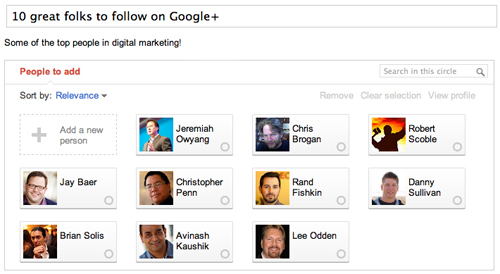
10 great digital folks to follow on Google Plus

10 great folks to follow on Google+

This post was originally published on Smart Insights on 6th February 2012. I cross-post it here with all the links and tags for your reading pleasure!

Ever since Google+ burst onto the social media scene in July last year, the blogosphere has been awash with debate on the pros and cons of the new social network.

But what can’t be disputed is the calibre of digital experts populating Google+ and the amount of insight and expertise they offer up on a daily basis.

If you’re new to Google+ or just looking for some ideas on who to follow (or ‘Circle’, as it’s known on Google+), the following is a list of 10 great digital experts to get you started:

Brian Solis

Brian Solis is a new media strategist and blogger as well as Principle at the analyst group Altimeter. He’s also the author of two books: Engage and The End of Business as Usual.

Brian primarily uses Google+ to cross-promote his own blog posts and YouTube videos but he also shares his thoughts on new media trends and developments within the comments on each of his posts.

Chris Brogan

Chris Brogan is one of the leading thought-leaders on digital marketing and was a very early adopter of Google+ (so much so that he’s even written a business book on it. He is an outspoken advocate of the social network and regularly blogs about how it can be leveraged by individuals and businesses alike.

Because Google+ is now Chris’s primary social media outpost, he not only promotes his own content on the site but regularly shares other people’s, too as well as encouraging his followers to join in on a range of discussions on his page.

Robert Scoble

Robert Scoble is a blogger, author and technology evangelist based in Silicon Valley. He is a leading authority on everything tech and is usually first with an incisive opinion on current technology affairs.

Although Robert blogs at scobleizer.com, he also uses Google+ as a blog itself. As a result, in addition to sharing other people’s posts (to which he often adds his own opinions), photographs and links, he regularly posts detailed, thoughtful posts on everything from major tech events to social networking developments.

Dave Chaffey

Smart Insights‘ Dave Chaffey is digital marketing trainer, consultant and author of over 20 books, many of which are now in their fourth or fifth editions and have translated into several different languages.

Dave has a background teaching in higher education and this is evident in his use of Google+. Dave uses the social network to share and educate his audience on the latest best practices in digital marketing by sharing posts from Smart Insights and others people’s work, too.

Rand Fishkin

Rand Fishkin is a search marketing heavyweight with an immense amount of experience and expertise in everything ranging from search engine optimisation to social media and inbound marketing.

As co-founder and CEO of SEOMoz [http://www.seomoz.org], Rand’s Google+ posts naturally lean towards SEO and search marketing, although he also looks at the convergence of social media and search and how this is impacting digital marketing strategy.

Jeremiah Owyang

Jeremiah Owyang is a leading web strategist and a new media ‘big thinker’. As a principle analyst at Altimeter, Jeremiah looks very closely at the latest trends and developments in the digital space.

Although Jeremiah uses Google+ to promote his and Altimeter’s content and research, he also uses it for fun, too. His mix of social media analyst reports with beatbox YouTube videos makes him a great person to Circle!

Christopher Penn

Christopher S Penn is one half of the Marketing Over Coffee podcast duo and is an avid blogger and self-appointed ‘bridge’, standing between different fields, professions and ideas (primarily IT and marketing) to help people on both sides understand each other.

Chris uses Google+ in two ways: to say ‘good morning’ (every day) to both his current and new followers and to participate in #the5 – a hashtag trend originally started on Twitter in which he shares five things that caught his eye in the morning news related to marketing, search, social media and fun!

Jay Baer

Jay Baer is a leading social media blogger, consultant and strategist and the co-author of the book The Now Revolution.

Jay Baer uses Google+ to post both original content and share other people’s primarily related to social media tactics, tools and strategy but also looks at other areas of digital marketing including technology, SEO and content marketing, too.

Lee Odden

Lee Odden is the mastermind behind TopRank Online Marketing, a digital marketing and PR company and the highly influential TopRank blog.

Lee is a hugely passionate marketer and it shows in the content he produces and shares on Google+. Being a very customer-centric marketer, Lee often posts about search, social media and content marketing and how these can be leveraged to improve the customer experience.

Avinash Kaushik

It’s fair to say that Avinash Kaushik is a bona fide analytics guru (and I don’t use that word lightly!). Avinash is a blogger and the author of two leading books on web analytics: Web Analytics: An Hour a Day and Web Analytics 2.0.

Although Avinash uses Google+ to post about web analytics he also uses the social network to blog about everything else that interests him, including travel, sport and culture. His mix of business and pleasure makes him a super fun person to follow!

Danny Sullivan

Danny Sullivan is a search engine specialist helping marketers, webmasters and everyday web users understand how search engines work and how they impact the web.

Danny is editor-in-chief at Search Engine Land and therefore a lot of the content he provides on Google+ is related to Google, SEO, PPC and search engines. However, being based in Newport Beach, California, Danny also likes to post jealousy-inducing updates and pictures of sunny days by the seaside!

There are of course SO MANY more great people to follow (I could easily list 100!). Who would you recommend people to follow on Google+?


The Vapiano customer experience

Vapiano
Last week I had the good fortune to travel to Munich in Germany and whilst there I stopped by one of my favourite Italian-themed restaurants – Vapiano.

Although the German restaurant chain has expanded into other countries (including the UK) over the last few years, I had never encountered Vapiano until I first visited Munich back in 2010. Apart from the great food, atmosphere and location of the Munich restaurant, I also like going to Vapiano because I am intrigued by their innovative customer experience!

First impressions

Vapiano first impressions

What is immediately different from many other restaurants is what you encounter when you first enter the restaurant.

After being greeted by an attendant you’re provided with a chip card which is used to store information on everything you order. This takes away the need for wait staff and allows the customer to order what they want, when they want.

The layout of the restaurant is quite expansive and furnished with tall tables and stools as well as benches for groups to eat and drink together. It’s fairly minimalist and yet has a comfortable, friendly feel to it at the same time.

There is a ‘light’, fun atmosphere to the premises, which is well lit and decorated with black and white photography of Italian style and fashion.

Ordering

Vapiano ordering experience

Where the customer experience gets interesting is how you order your food and what happens afterwards.

Behind a long bar that stretches across the entire top floor of the restaurant is a number of cooks standing by waiting to take your order. Once you tell them what you want, they prepare your meal right in front of your eyes!

What I like most about this experience is that the customer can see exactly how their food is being cooked and prepared. All ingredients are fresh, from the pasta to the sauce, and you can tell the cook directly what you want adding or taking away (for example extra chillies, garlic or parmesan cheese).

By cooking someone’s meal right in front of them gives the customer a ‘behind-the-scenes’ feeling and allows them to not only see but smell all the ingredients come together.

Drawbacks

Along with the advantages are some notable downsides.

The restaurant can get very busy during peak periods (weekend lunchtimes and evenings especially) and when this happens queues form behind the ordering bar. Because everyone’s meals are individually prepared, there can be a fairly long wait should there be several people in front of you.

Vapiano are also very strict about the chip card and staff can get annoyed should you stray toward the exit if you haven’t paid!

Something different

I like Vapiano because it offers something different to anything I’ve experienced in the UK. It helps that I’m a big fan of Italian food but I’m also an advocate for good food, too, and that’s exactly what you get at Vapiano.

I’m also an admirer of interesting customer experiences. Although Vapiano’s doesn’t appeal to everyone, it nevertheless works because it breaks from the norm and gives customers a dining experience that is unique, fun and they won’t find everywhere else.


What makes a great new media marketer?

Uplifting Hero by JD Hancock

As marketing continues to evolve and merge ever more into the new media world, the demand for smart, savvy digital marketers will increase.

Many companies, both large and small, are looking for new media marketers who have a broad range of skills, can adapt quickly and add value to a business despite the tough economic conditions.

So what are the key attributes of a great new media marketer? What are the signs that set them apart from everyone else?

Technical skills and awareness as well as a good understanding of the latest tools and techniques should be a given. So I’ve looked at some of the higher-level attributes that I believe make for a great new media marketer:

They have a holistic approach to marketing

A great new media marketer will have a diverse skill-set. They will not be specialists in one key area (for example, SEO or web analytics) but have experience of dealing with social media, web advertising or email marketing, too.

They will also have experience of traditional marketing, such as PR, advertising and event management. By having a holistic approach to all areas of marketing they will be able to see how new media will effectively fit into a company’s marketing mix.

They are customer-focused

This is a prerequisite for any marketer, new media or not, but it’s worth reinforcing the point anyway.

Great new media marketers have a customer-centric view that enables them to see things from the customer’s point-of view. This is an essential skill as it allows them to take a step back and understand the customer experience.

They frequent top new media and internet marketing blogs

New media marketing is in a state of constant change. New channels, approaches and ideas are being introduced on an almost daily basis.

A great new media marketer will be an avid reader of top online and digital marketing blogs. Reading the posts of these blogs will give them valuable insights and an excellent perspective on the latest trends, changes and innovations that are taking place.

They truly understand the company and what it stands for

There is really not much point in being bogged down in detail or working in a silo away from everyone else. In order to work effectively, you need to have an appreciation of how a company works as a whole and what it really stands for.

A great new media marketer will have a deep understanding of a business from the inside out. They will know about the industry the company is operating in, the business’s vision and strategy, company culture, product/ service offerings and a good impression of the entire customer experience.

Only by fully understanding the company, it’s goals and what it wants to achieve can one produce genuinely important, meaningful work.

They are effective communicators

Great new media marketers have the ability to present their opinions, insights and recommendations in a compelling, easy-to-understand manner whilst simultaneously exuding passion and enthusiasm for their craft.

It’s easy to get caught up in the detail and convoluted language of digital marketing and therefore good communication is about breaking concepts and ideas down into their simplest form for everyone (including senior management) to understand.

They are business-savvy

A good understanding of the financial perspective of a business is essential, especially during tough times when companies are watching their pennies and demanding a return on every investment.

In order to get the most from their work, great new media marketers will be able to tie digital marketing activities to the company’s overall strategy, plan effectively and use appropriate metrics to measure success and make necessary adjustments and changes.

They are technically adept

All new media marketers must have a deep understanding of the technical aspects of everything they’re expected to work on, from search engine optimisation to mobile marketing.

However, great new media marketers are constantly looking for ways to improve their technical skills, particularly in reference to the company or clients they’re working for. They proactively read and contribute to blogs, attend webinars, events and specialist courses to stay ahead of the game.

They are analytical

Great new media marketers must have good analytical skills. Basic reporting is not enough.

Good analysis is about using data to manage complexity, pick out trends and provide actionable insights that key decision-makers can act upon.

They are open-minded and inquisitive

A great new media marketer will always be looking for new and innovative ways to add value. This isn’t about jumping on the bandwagon of the latest craze but about carefully matching new developments and trends to a company’s business needs.

With everything changing so much so quickly, new media marketers must be be hungry to explore and seek out other possible solutions to companies’ problems.

They are problem solvers

Whatever the company is trying to do, a great new media marketer should be able to help them do it.

Whether it’s launching a new product into a new market, improving lead generation for the sales team or internal marketing, there are endless ways of working with other teams and departments within a company to help them meet their objectives.

This is just a handful of attributes out of many. What are the other top signs of a great new media marketer?